consider the four hydrocarbons in the table below. one is an alkyne, and the other three are alkenes.\n|…
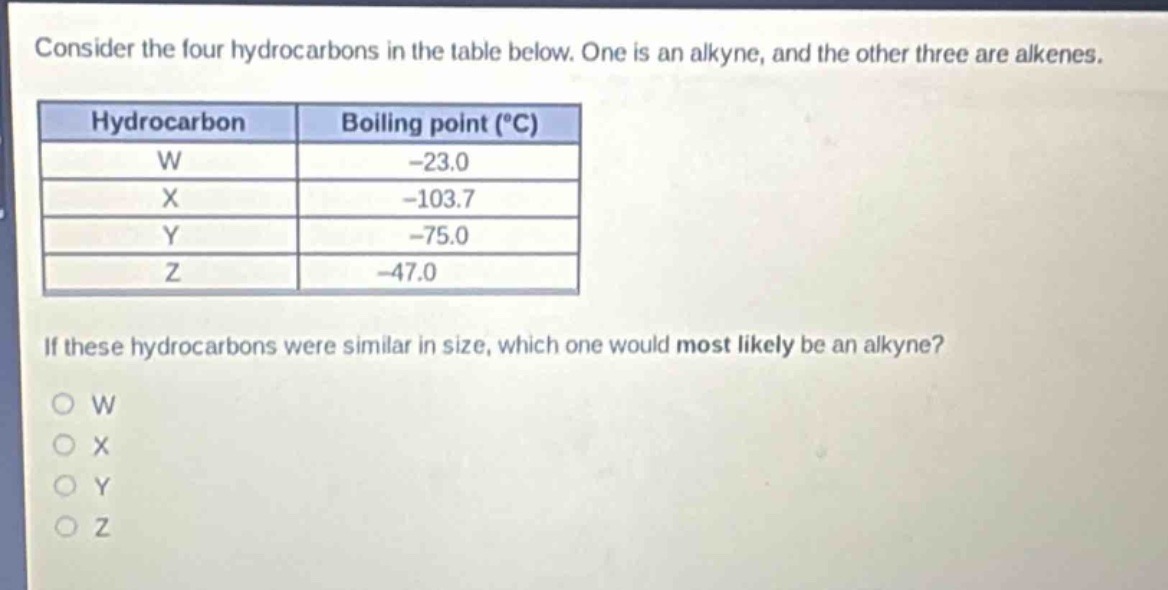
consider the four hydrocarbons in the table below. one is an alkyne, and the other three are alkenes.\n| hydrocarbon | boiling point (°c) |\n| ---- | ---- |\n| w | -23.0 |\n| x | -103.7 |\n| y | -75.0 |\n| z | -47.0 |\nif these hydrocarbons were similar in size, which one would most likely be an alkyne?\no w\no x\no y\no z
Answer
Explanation:
Step1: Recall boiling - point trend
Alkynes have higher boiling - points than alkenes of similar size due to stronger London dispersion forces resulting from their more linear shape and greater electron density.
Step2: Identify the highest boiling - point hydrocarbon
Among the given boiling points: $- 103.7^{\circ}C$, $-75.0^{\circ}C$, $-47.0^{\circ}C$, and $-23.0^{\circ}C$, the highest boiling - point is $-23.0^{\circ}C$ which corresponds to hydrocarbon W.
Answer:
W