consider the half reactions below for a chemical reaction. mg→mg²⁺(aq)+2e⁻ 2h⁺(aq)+2e⁻→h₂(g) what is the…
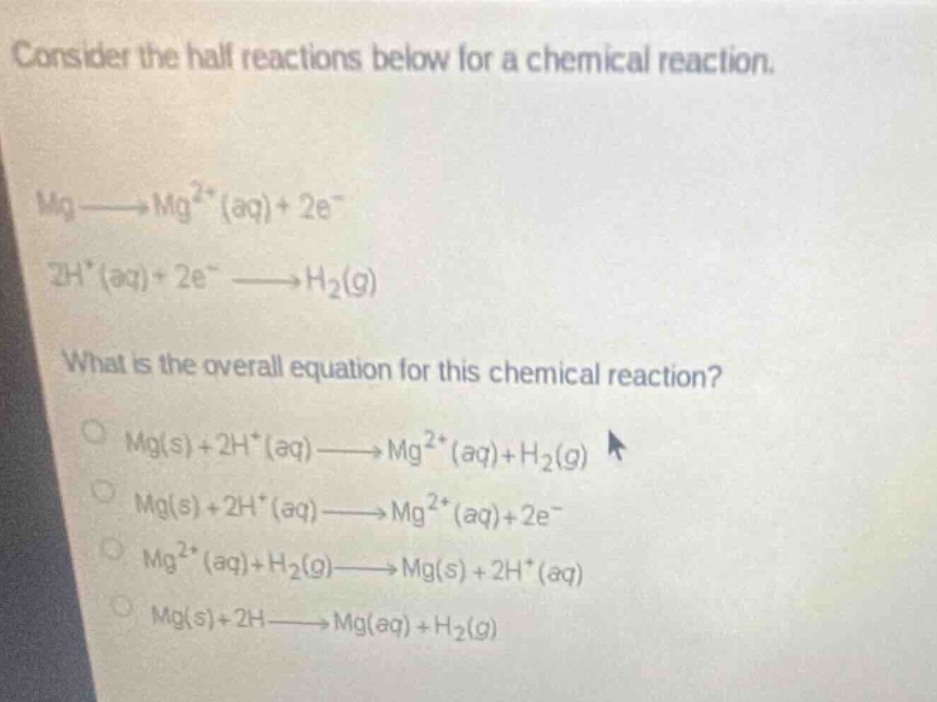
consider the half reactions below for a chemical reaction. mg→mg²⁺(aq)+2e⁻ 2h⁺(aq)+2e⁻→h₂(g) what is the overall equation for this chemical reaction? mg(s)+2h⁺(aq)→mg²⁺(aq)+h₂(g) mg(s)+2h⁺(aq)→mg²⁺(aq)+2e⁻ mg²⁺(aq)+h₂(g)→mg(s)+2h⁺(aq) mg(s)+2h→mg(aq)+h₂(g)
Answer
Explanation:
Step1: Identify the half - reactions
Oxidation: $Mg\rightarrow Mg^{2 +}(aq)+2e^{-}$ Reduction: $2H^{+}(aq)+2e^{-}\rightarrow H_{2}(g)$
Step2: Combine the half - reactions
Add the two half - reactions together. The electrons on both sides cancel out. $Mg + 2H^{+}(aq)\rightarrow Mg^{2 +}(aq)+H_{2}(g)$
Answer:
$Mg(s)+2H^{+}(aq)\rightarrow Mg^{2 +}(aq)+H_{2}(g)$ (the first option in the multiple - choice list)