consider the reaction in chemical equilibrium.\ncocl₂(g) ⇌ co(g) + cl₂(g)\nwhich is the correct equation for…
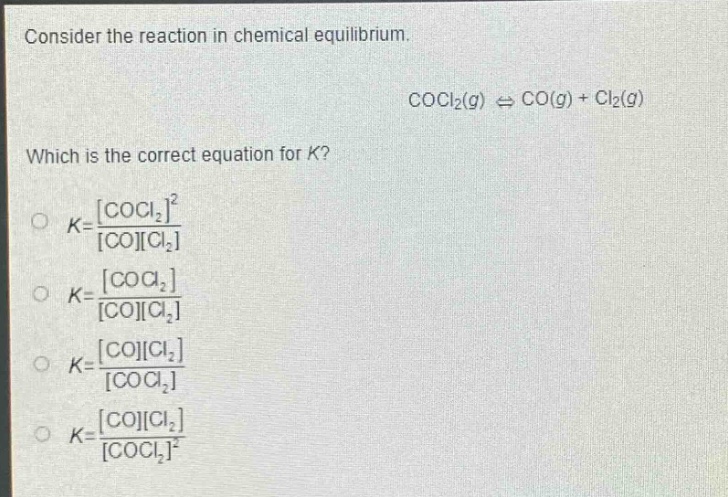
consider the reaction in chemical equilibrium.\ncocl₂(g) ⇌ co(g) + cl₂(g)\nwhich is the correct equation for k?\nk = \\frac{cocl₂²}{cocl₂}\nk = \\frac{cocl₂}{cocl₂}\nk = \\frac{cocl₂}{cocl₂}\nk = \\frac{cocl₂}{cocl₂²}
Answer
Answer:
C. $K = \frac{[\text{CO}][\text{Cl}_2]}{[\text{COCl}_2]}$
Explanation:
Step1: Recall equilibrium - constant expression
For a reaction $a\text{A}+b\text{B}\rightleftharpoons c\text{C} + d\text{D}$, $K=\frac{[\text{C}]^c[\text{D}]^d}{[\text{A}]^a[\text{B}]^b}$.
Step2: Identify reactants and products
In $\text{COCl}_2(g)\rightleftharpoons\text{CO}(g)+\text{Cl}_2(g)$, $\text{COCl}_2$ is the reactant and $\text{CO}$ and $\text{Cl}_2$ are products.
Step3: Write the equilibrium - constant expression
The stoichiometric coefficients of all species are 1. So $K = \frac{[\text{CO}][\text{Cl}_2]}{[\text{COCl}_2]}$.