consider the reaction below.\nzn(s)+cu^{2 + }(aq)→zn^{2 + }(aq)+cu(s)\nwhich half - reaction correctly…
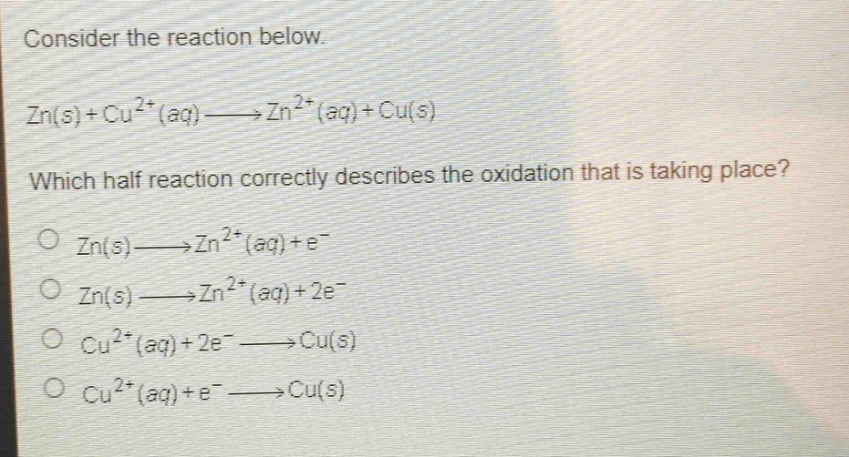
consider the reaction below.\nzn(s)+cu^{2 + }(aq)→zn^{2 + }(aq)+cu(s)\nwhich half - reaction correctly describes the oxidation that is taking place?\no zn(s)→zn^{2 + }(aq)+e^{-}\no zn(s)→zn^{2 + }(aq)+2e^{-}\no cu^{2 + }(aq)+2e^{-}→cu(s)\no cu^{2 + }(aq)+e^{-}→cu(s)
Answer
Answer:
B. $\text{Zn}(s)\longrightarrow\text{Zn}^{2 +}(aq)+2e^-$
Explanation:
Step1: Define oxidation
Oxidation is loss of electrons.
Step2: Analyze zinc reaction
Zinc goes from 0 oxidation state in $\text{Zn}(s)$ to +2 in $\text{Zn}^{2+}(aq)$. It loses 2 electrons. The correct half - reaction for zinc oxidation is $\text{Zn}(s)\longrightarrow\text{Zn}^{2 +}(aq)+2e^-$.
Step3: Analyze copper reactions
The reactions with copper involve gain of electrons ($\text{Cu}^{2+}(aq)+2e^-\longrightarrow\text{Cu}(s)$ or $\text{Cu}^{2+}(aq)+e^-\longrightarrow\text{Cu}(s)$), which are reduction half - reactions, not oxidation. So the oxidation half - reaction is $\text{Zn}(s)\longrightarrow\text{Zn}^{2 +}(aq)+2e^-$.