consider the reaction below. zn(s)+cu²⁺(aq)→zn²⁺(aq)+cu(s) which half - reaction correctly describes the…
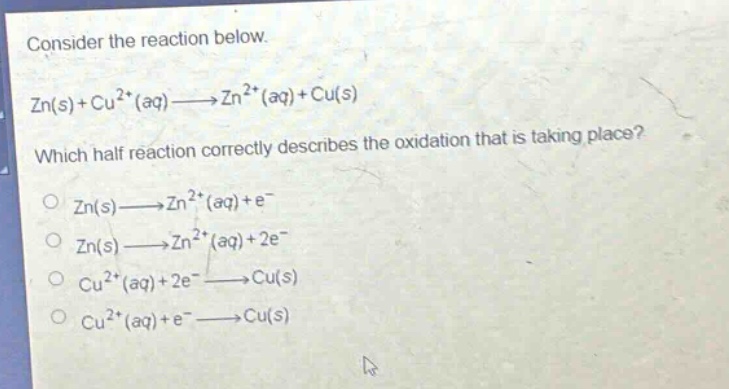
consider the reaction below. zn(s)+cu²⁺(aq)→zn²⁺(aq)+cu(s) which half - reaction correctly describes the oxidation that is taking place? zn(s)→zn²⁺(aq)+e⁻ zn(s)→zn²⁺(aq)+2e⁻ cu²⁺(aq)+2e⁻→cu(s) cu²⁺(aq)+e⁻→cu(s)
Answer
Answer:
Zn(s) $\longrightarrow$ Zn$^{2+}$(aq)+2e$^-$
Explanation:
Step1: Define oxidation
Oxidation is loss of electrons.
Step2: Analyze Zn reaction
Zn goes from 0 oxidation state in Zn(s) to +2 in Zn$^{2+}$(aq) and loses 2 electrons. So the half - reaction is Zn(s) $\longrightarrow$ Zn$^{2+}$(aq)+2e$^-$.
Step3: Analyze Cu reactions
Cu$^{2+}$ gaining electrons (Cu$^{2+}$(aq)+2e$^-\longrightarrow$Cu(s) or Cu$^{2+}$(aq)+e$^-\longrightarrow$Cu(s)) is reduction, not oxidation.