consider the substances below.\n- 1 mol of beryllium\n- 1 mol of salt\n- 1 mol of water\n- 1 mol of…
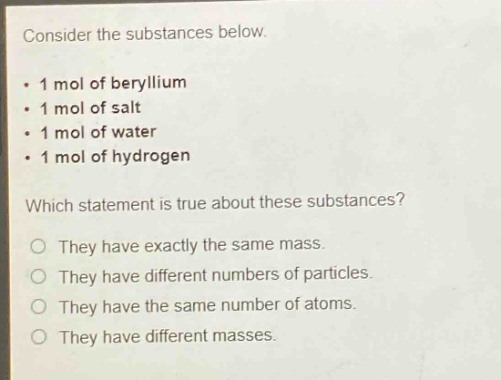
consider the substances below.\n- 1 mol of beryllium\n- 1 mol of salt\n- 1 mol of water\n- 1 mol of hydrogen\nwhich statement is true about these substances?\no they have exactly the same mass.\no they have different numbers of particles.\no they have the same number of atoms.\no they have different masses.
Answer
Answer:
They have different masses.
Explanation:
Step1: Recall mole - particle relationship
1 mole of any substance contains Avogadro's number ($6.022\times 10^{23}$) of particles. So, 1 mol of beryllium, 1 mol of salt (e.g., NaCl), 1 mol of water ($H_2O$) and 1 mol of hydrogen (assuming $H_2$) have the same number of particles.
Step2: Analyze atomic - molecular composition
Beryllium (Be) is an element. Salt (NaCl) is a compound. Water ($H_2O$) is a compound and hydrogen ($H_2$) is a molecule. They have different atomic compositions and thus different molar masses.
Step3: Determine mass relationship
Since mass $m = n\times M$ (where $n = 1$ mol for all substances here and $M$ is the molar mass), and they have different molar masses, they have different masses.