consider the total ionic equation below. 2h⁺ + cro₄²⁻ + ba²⁺ + 2oh⁻ → ba²⁺ + cro₄²⁻ + 2h₂o what are the…
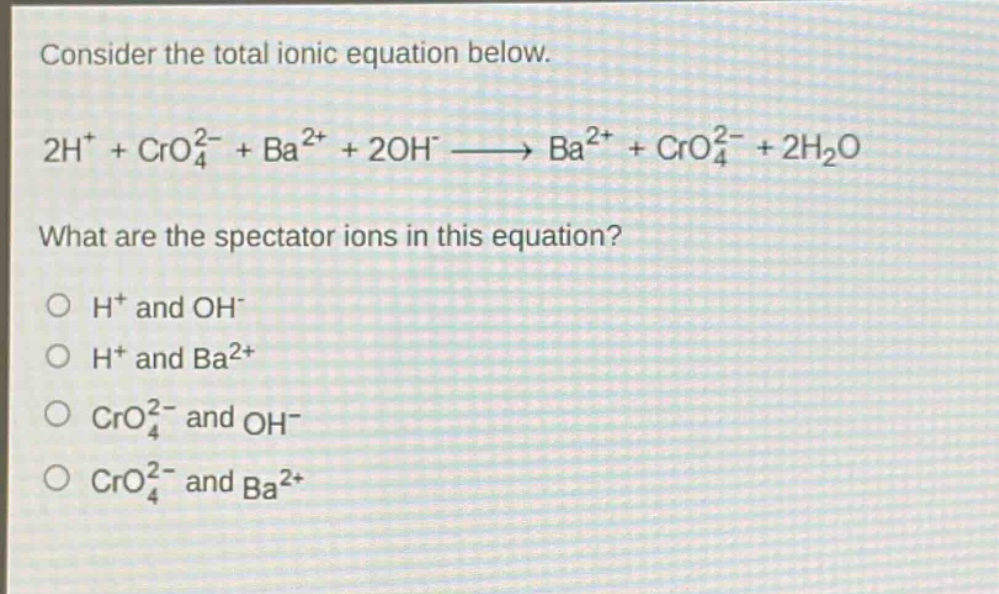
consider the total ionic equation below. 2h⁺ + cro₄²⁻ + ba²⁺ + 2oh⁻ → ba²⁺ + cro₄²⁻ + 2h₂o what are the spectator ions in this equation? o h⁺ and oh⁻ o h⁺ and ba²⁺ o cro₄²⁻ and oh⁻ o cro₄²⁻ and ba²⁺
Answer
Answer:
D. $\text{CrO}_{4}^{2 -}$ y $\text{Ba}^{2 +}$
Explanation:
Step1: Definir iones espectadores
Los iones espectadores son aquellos que no participan en una reacción química real, es decir, que aparecen en ambos lados de la ecuación iónica total sin cambiar.
Step2: Analizar los iones en la ecuación
En la ecuación $2\text{H}^+ + \text{CrO}{4}^{2 -}+\text{Ba}^{2 +}+2\text{OH}^-\longrightarrow\text{Ba}^{2 +}+\text{CrO}{4}^{2 -}+2\text{H}2\text{O}$, los iones $\text{Ba}^{2 +}$ y $\text{CrO}{4}^{2 -}$ están en ambos lados de la ecuación sin sufrir cambios químicos. Los iones $\text{H}^+$ y $\text{OH}^-$ se combinan para formar agua. Entonces, $\text{Ba}^{2 +}$ y $\text{CrO}_{4}^{2 -}$ son los iones espectadores.