count the atoms of each element on both sides of the equation to determine if it is balanced or not. if the…
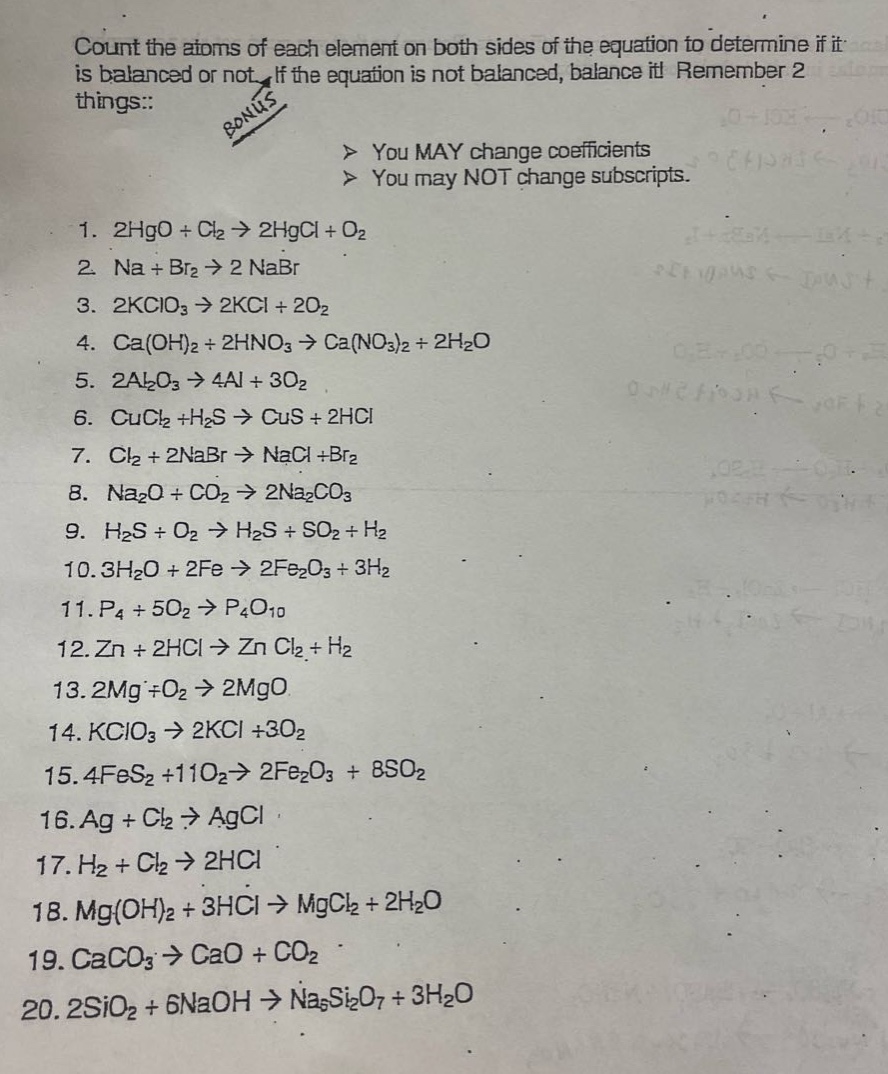
count the atoms of each element on both sides of the equation to determine if it is balanced or not. if the equation is not balanced, balance it! remember 2 things:: > you may change coefficients > you may not change subscripts. 1. 2hgo + cl2 → 2hgcl + o2 2. na + br2 → 2nabr 3. 2kclo3 → 2kcl + 2o2 4. ca(oh)2 + 2hno3 → ca(no3)2 + 2h2o 5. 2al2o3 → 4al + 3o2 6. cucl2 +h2s → cus + 2hcl 7. cl2 + 2nabr → nacl +br2 8. na2o + co2 → 2na2co3 9. h2s + o2 → h2s + so2 + h2 10. 3h2o + 2fe → 2fe2o3 + 3h2 11. p4 + 5o2 → p4o10 12. zn + 2hcl → zn cl2 + h2 13. 2mg +o2 → 2mgo 14. kclo3 → 2kcl +3o2 15. 4fes2 +11o2→ 2fe2o3 + 8so2 16. ag + cl2 → agcl 17. h2 + cl2 → 2hcl 18. mg(oh)2 + 3hcl → mgcl2 + 2h2o 19. caco3 → cao + co2 20. 2sio2 + 6naoh → na5si2o7 + 3h2o
Answer
Answer:
- Un - balanced: $2HgO + Cl_2\rightarrow 2HgCl + O_2$ can be balanced as $2HgO + Cl_2\rightarrow 2HgCl + O_2$ (already in a form where we can see the imbalance, to balance oxygen we would need to adjust coefficients further. The balanced form is $2HgO + Cl_2\rightarrow 2HgCl + O_2$).
- Balanced: For $Na + Br_2\rightarrow 2NaBr$, on the left - hand side, we have 1 Na and 2 Br. On the right - hand side, we have 2 Na and 2 Br. To balance Na, we put a 2 in front of Na on the left - hand side: $2Na+Br_2\rightarrow 2NaBr$.
- Un - balanced: In $2KClO_3\rightarrow 2KCl + 2O_2$, for oxygen, on the left - hand side we have $2\times3 = 6$ oxygen atoms and on the right - hand side we have $2\times2=4$ oxygen atoms. The balanced equation is $2KClO_3\rightarrow 2KCl + 3O_2$.
- Balanced: For $Ca(OH)_2+2HNO_3\rightarrow Ca(NO_3)_2 + 2H_2O$, on the left - hand side: 1 Ca, 2 O (from $Ca(OH)_2$), 2 H (from $Ca(OH)_2$), 2 H (from $HNO_3$), 2 N, 6 O (from $HNO_3$). On the right - hand side: 1 Ca, 2 N, 6 O, 4 H, 2 O.
- Balanced: In $2Al_2O_3\rightarrow 4Al + 3O_2$, on the left - hand side we have 4 Al and 6 O. On the right - hand side we have 4 Al and 6 O.
- Balanced: For $CuCl_2+H_2S\rightarrow CuS + 2HCl$, on the left - hand side: 1 Cu, 2 Cl, 2 H, 1 S. On the right - hand side: 1 Cu, 2 Cl, 2 H, 1 S.
- Un - balanced: In $Cl_2+2NaBr\rightarrow NaCl + Br_2$, on the left - hand side we have 2 Cl, 2 Na, 2 Br. On the right - hand side we have 1 Na, 1 Cl, 2 Br. The balanced equation is $Cl_2 + 2NaBr\rightarrow 2NaCl+Br_2$.
- Un - balanced: For $Na_2O+CO_2\rightarrow 2Na_2CO_3$, on the left - hand side we have 2 Na, 1 O (from $Na_2O$), 1 C, 2 O (from $CO_2$). On the right - hand side we have 4 Na, 1 C, 6 O. The balanced equation is $Na_2O + CO_2\rightarrow Na_2CO_3$.
- Un - balanced: In $H_2S+O_2\rightarrow H_2S + SO_2+H_2$, this equation has $H_2S$ on both sides which is incorrect. The correct reaction might be $2H_2S + 3O_2\rightarrow 2SO_2+2H_2O$.
- Un - balanced: For $3H_2O + 2Fe\rightarrow 2Fe_2O_3+3H_2$, on the left - hand side we have 6 H, 3 O, 2 Fe. On the right - hand side we have 6 H, 6 O, 4 Fe. The balanced equation is $3H_2O+2Fe\rightarrow Fe_2O_3 + 3H_2$ (but this is still un - balanced, the correct balanced equation is $4H_2O+3Fe\rightarrow Fe_3O_4 + 4H_2$).
- Balanced: In $P_4+5O_2\rightarrow P_4O_{10}$, on the left - hand side we have 4 P and 10 O. On the right - hand side we have 4 P and 10 O.
- Balanced: For $Zn + 2HCl\rightarrow ZnCl_2+H_2$, on the left - hand side we have 1 Zn, 2 H, 2 Cl. On the right - hand side we have 1 Zn, 2 H, 2 Cl.
- Balanced: In $2Mg+O_2\rightarrow 2MgO$, on the left - hand side we have 2 Mg and 2 O. On the right - hand side we have 2 Mg and 2 O.
- Un - balanced: In $KClO_3\rightarrow 2KCl + 3O_2$, on the left - hand side we have 1 K, 1 Cl, 3 O. On the right - hand side we have 2 K, 2 Cl, 6 O. The balanced equation is $2KClO_3\rightarrow 2KCl+3O_2$.
- Balanced: For $4FeS_2+11O_2\rightarrow 2Fe_2O_3+8SO_2$, on the left - hand side: 4 Fe, 8 S, 22 O. On the right - hand side: 4 Fe, 8 S, 22 O.
- Un - balanced: In $Ag + Cl_2\rightarrow AgCl$, on the left - hand side we have 1 Ag and 2 Cl. On the right - hand side we have 1 Ag and 1 Cl. The balanced equation is $2Ag+Cl_2\rightarrow 2AgCl$.
- Balanced: For $H_2+Cl_2\rightarrow 2HCl$, on the left - hand side we have 2 H and 2 Cl. On the right - hand side we have 2 H and 2 Cl.
- Un - balanced: In $Mg(OH)_2+3HCl\rightarrow MgCl_2+2H_2O$, on the left - hand side we have 1 Mg, 2 O, 5 H, 3 Cl. On the right - hand side we have 1 Mg, 2 O, 4 H, 2 Cl. The balanced equation is $Mg(OH)_2 + 2HCl\rightarrow MgCl_2+2H_2O$.
- Balanced: In $CaCO_3\rightarrow CaO + CO_2$, on the left - hand side we have 1 Ca, 1 C, 3 O. On the right - hand side we have 1 Ca, 1 C, 3 O.
- Un - balanced: For $2SiO_2+6NaOH\rightarrow Na_5Si_2O_7+3H_2O$, on the left - hand side we have 2 Si, 10 O, 6 Na, 6 H. On the right - hand side we have 2 Si, 10 O, 5 Na, 6 H. The balanced equation is $2SiO_2 + 6NaOH\rightarrow Na_2Si_2O_5+3H_2O+4NaOH$ (or a more standard form considering the correct product might be $2SiO_2+6NaOH\rightarrow Na_2Si_2O_5 + 4Na^++ 3H_2O$).
Explanation:
Step1: Identify elements on both sides
For each chemical equation, list all elements present on the left - hand side (reactants) and right - hand side (products).
Step2: Count atom numbers
Count the number of atoms of each element on the reactant and product sides.
Step3: Determine balance
If the number of atoms of each element is the same on both sides, the equation is balanced. If not, adjust the coefficients (while keeping sub - scripts constant) to make the atom numbers equal for all elements.