crude oil may contain hundreds of different types of hydrocarbons. some examples include: butane(c4h10)…
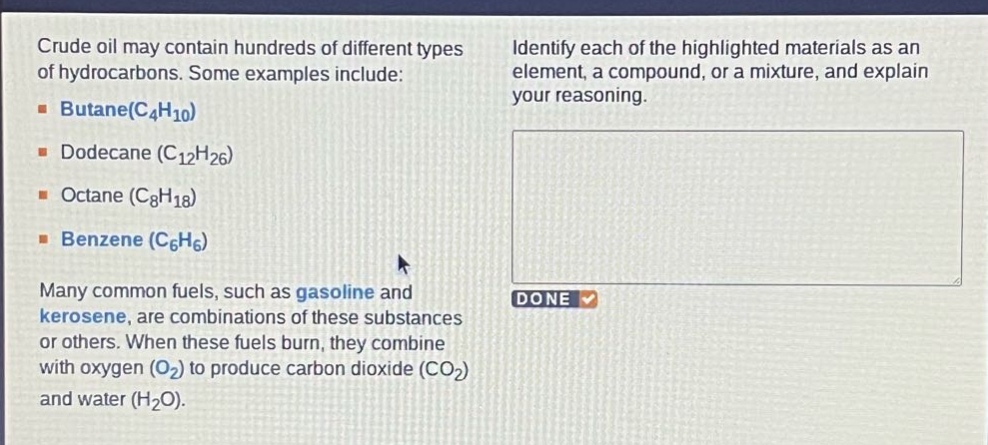
crude oil may contain hundreds of different types of hydrocarbons. some examples include: butane(c4h10) dodecane (c12h26) octane (c8h18) benzene (c6h6) many common fuels, such as gasoline and kerosene, are combinations of these substances or others. when these fuels burn, they combine with oxygen (o2) to produce carbon dioxide (co2) and water (h2o). identify each of the highlighted materials as an element, a compound, or a mixture, and explain your reasoning.
Answer
Brief Explanations:
Butane ($C_4H_{10}$), dodecane ($C_{12}H_{26}$), octane ($C_8H_{18}$), benzene ($C_6H_6$) are compounds as they are made up of two or more different elements (carbon and hydrogen) chemically combined in fixed ratios. Gasoline and kerosene are mixtures since they are combinations of multiple substances (such as different hydrocarbons). Oxygen ($O_2$), carbon - dioxide ($CO_2$) and water ($H_2O$) are compounds. $O_2$ is a di - atomic molecule of the same element, but still considered a compound in a chemical context as it is a distinct chemical entity. $CO_2$ is made of carbon and oxygen chemically combined, and $H_2O$ is made of hydrogen and oxygen chemically combined.
Answer:
Butane: Compound, made of carbon and hydrogen in fixed ratio. Dodecane: Compound, made of carbon and hydrogen in fixed ratio. Octane: Compound, made of carbon and hydrogen in fixed ratio. Benzene: Compound, made of carbon and hydrogen in fixed ratio. Gasoline: Mixture, combination of hydrocarbons. Kerosene: Mixture, combination of hydrocarbons. Oxygen: Compound (diatomic molecule). Carbon - dioxide: Compound, carbon and oxygen combined. Water: Compound, hydrogen and oxygen combined.