decide whether these proposed lewis structures are reasonable. proposed lewis structure is the proposed…
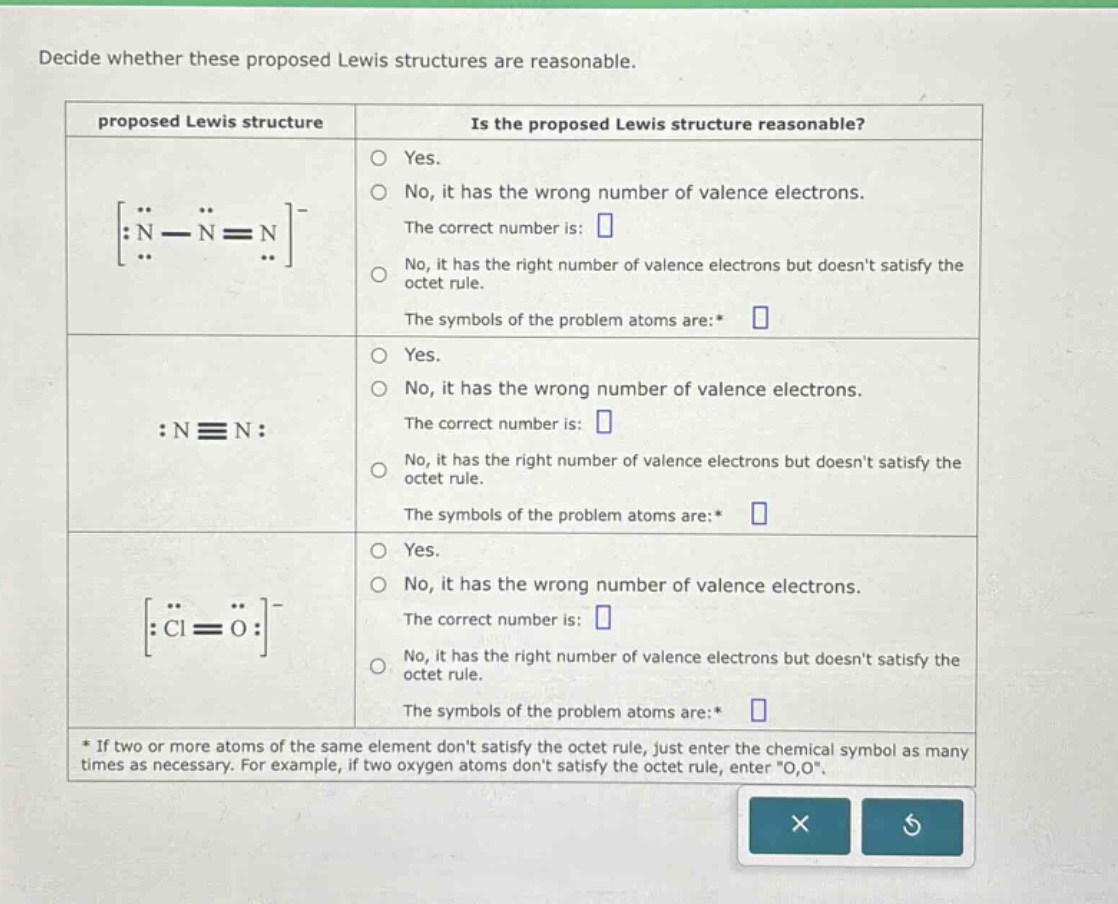
decide whether these proposed lewis structures are reasonable. proposed lewis structure is the proposed lewis structure reasonable? yes. no, it has the wrong number of valence electrons. the correct number is: no, it has the right number of valence electrons but doesnt satisfy the octet rule. the symbols of the problem atoms are:* yes. no, it has the wrong number of valence electrons. the correct number is: no, it has the right number of valence electrons but doesnt satisfy the octet rule. the symbols of the problem atoms are:* yes. no, it has the wrong number of valence electrons. the correct number is: no, it has the right number of valence electrons but doesnt satisfy the octet rule. the symbols of the problem atoms are:* * if two or more atoms of the same element dont satisfy the octet rule, just enter the chemical symbol as many times as necessary. for example, if two oxygen atoms dont satisfy the octet rule, enter \o,o\.
Answer
Explanation:
Step1: Calculate valence - electrons for $[\text{N}-\text{N}=\text{N}]^{-}$
N has 5 valence electrons. There are 3 N atoms and a negative charge. So the total number of valence electrons should be $3\times5 + 1=16$. In the given structure, the number of valence electrons is $2\times2 + 4\times2+2 = 14$. So it has the wrong number of valence electrons.
Step2: Calculate valence - electrons for $\text{N}\equiv\text{N}$
N has 5 valence electrons. For $\text{N}_2$, the total number of valence electrons is $2\times5 = 10$. In the given structure, there are $3\times2 + 2\times2=10$ valence electrons. And each N atom has an octet (triple - bond and a lone - pair), so it is reasonable.
Step3: Calculate valence - electrons for $[\text{Cl}=\text{O}]^{-}$
Cl has 7 valence electrons and O has 6 valence electrons, plus a negative charge. So the total number of valence electrons should be $7 + 6+1 = 14$. In the given structure, there are $4\times2+2\times2 = 12$ valence electrons. So it has the wrong number of valence electrons.
Answer:
- No, it has the wrong number of valence electrons. The correct number is: 16
- Yes.
- No, it has the wrong number of valence electrons. The correct number is: 14