a decrease in ph by 5 implies which of the following? a the h+ concentration increases by a factor of 5. b…
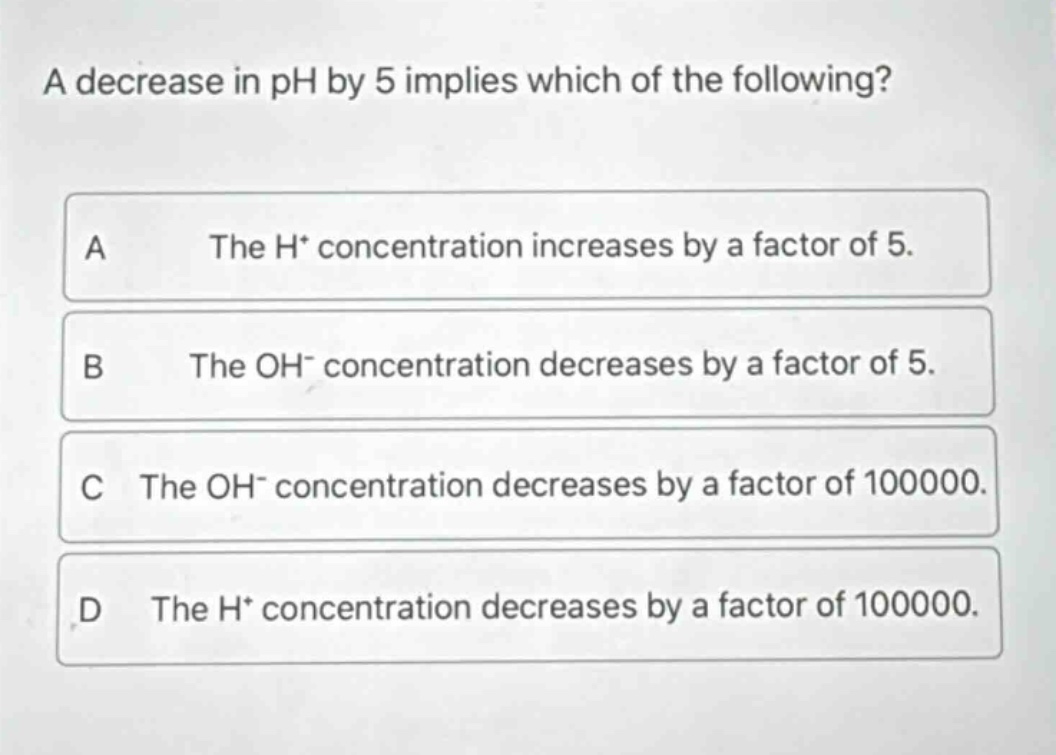
a decrease in ph by 5 implies which of the following? a the h+ concentration increases by a factor of 5. b the oh- concentration decreases by a factor of 5. c the oh- concentration decreases by a factor of 100000. d the h+ concentration decreases by a factor of 100000.
Answer
Explanation:
Step1: Recall pH formula
The pH is defined as $pH = -\log[H^+]$, and $[H^+][OH^-]=10^{- 14}$.
Step2: Analyze change in $[H^+]$ with pH change
If the initial pH is $pH_1=-\log[H^+_1]$ and the final pH is $pH_2 = pH_1 - 5=-\log[H^+_2]$. Then $-\log[H^+_1]+5=-\log[H^+_2]$, or $\log[H^+_2]-\log[H^+_1]=5$. Using the logarithm property $\log a-\log b=\log\frac{a}{b}$, we have $\log\frac{[H^+_2]}{[H^+_1]} = 5$, so $\frac{[H^+_2]}{[H^+_1]}=10^5$. The $H^+$ concentration increases by a factor of $10^5$.
Step3: Analyze change in $[OH^-]$
Since $[H^+][OH^-]=10^{-14}$, if $[H^+]$ increases by a factor of $10^5$, then $[OH^-]$ must decrease by a factor of $10^5$ (because their product is constant).
Answer:
C. The $OH^-$ concentration decreases by a factor of 100000.