describe the redox reaction. check all that apply. 2al(s) + 3zncl₂(g) → 3zn(s) + 2alcl₃(aq) aluminum atoms…
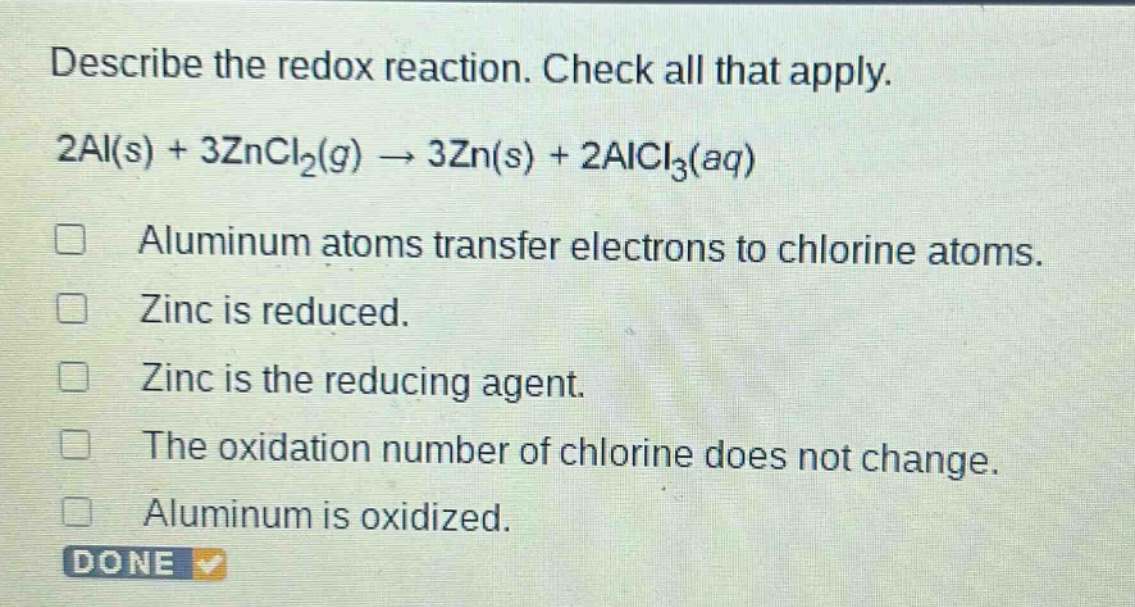
describe the redox reaction. check all that apply. 2al(s) + 3zncl₂(g) → 3zn(s) + 2alcl₃(aq) aluminum atoms transfer electrons to chlorine atoms. zinc is reduced. zinc is the reducing agent. the oxidation number of chlorine does not change. aluminum is oxidized. done
Answer
Brief Explanations:
- In the reaction (2Al(s)+3ZnCl_{2}(g)\rightarrow3Zn(s) + 2AlCl_{3}(aq)), aluminum ((Al)) goes from an oxidation - state of 0 to +3 in (AlCl_{3}), so aluminum is oxidized. Oxidation is the loss of electrons.
- Zinc ((Zn)) goes from an oxidation - state of +2 in (ZnCl_{2}) to 0 in (Zn), so zinc is reduced. Reduction is the gain of electrons.
- The reducing agent is the substance that causes reduction by losing electrons. Here, aluminum is the reducing agent as it donates electrons.
- Chlorine ((Cl)) has an oxidation - state of -1 in both (ZnCl_{2}) and (AlCl_{3}), so its oxidation number does not change. Also, aluminum atoms transfer electrons to zinc ions, not chlorine atoms.
Answer:
B. Zinc is reduced. D. The oxidation number of chlorine does not change. E. Aluminum is oxidized.