describe the redox reaction. check all that apply. 2na(s) + cl₂(g) → 2nacl(s) sodium atoms are oxidized…
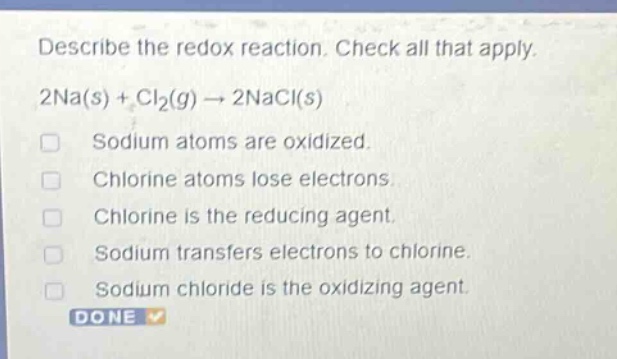
describe the redox reaction. check all that apply. 2na(s) + cl₂(g) → 2nacl(s) sodium atoms are oxidized. chlorine atoms lose electrons. chlorine is the reducing agent. sodium transfers electrons to chlorine. sodium chloride is the oxidizing agent.
Answer
Brief Explanations:
- In the reaction $2Na(s)+Cl_2(g)\rightarrow 2NaCl(s)$, sodium (Na) has an oxidation - state of 0 in its elemental form and +1 in NaCl. Oxidation is the loss of electrons, so sodium atoms are oxidized as they lose electrons to form $Na^+$.
- Chlorine (Cl) has an oxidation - state of 0 in $Cl_2$ and - 1 in NaCl. Chlorine atoms gain electrons, not lose them.
- The substance that gains electrons is the oxidizing agent. Since chlorine gains electrons, it is the oxidizing agent, not the reducing agent.
- Sodium, being oxidized, transfers electrons to chlorine which is being reduced.
- Sodium chloride is the product of the reaction, not an oxidizing or reducing agent.
Answer:
Sodium atoms are oxidized. Sodium transfers electrons to chlorine.