which describes the enthalpy change associated with an endothermic reaction? o it is negative because the…
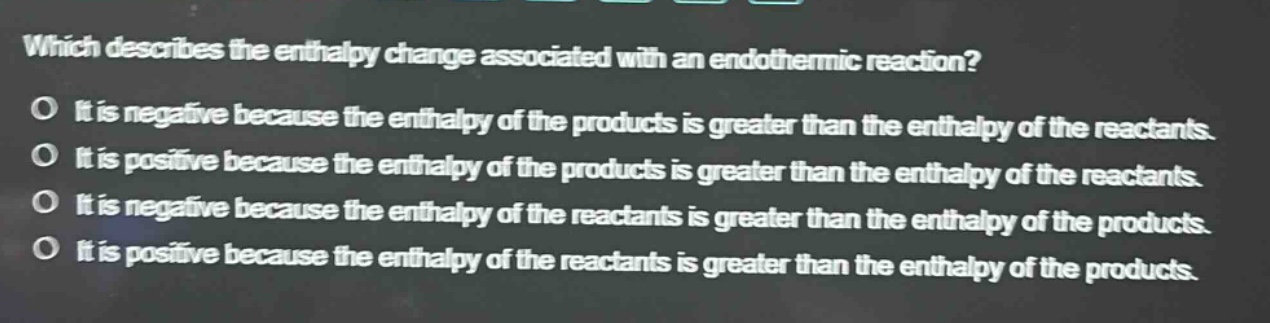
which describes the enthalpy change associated with an endothermic reaction? o it is negative because the enthalpy of the products is greater than the enthalpy of the reactants. o it is positive because the enthalpy of the products is greater than the enthalpy of the reactants. o it is negative because the enthalpy of the reactants is greater than the enthalpy of the products. o it is positive because the enthalpy of the reactants is greater than the enthalpy of the products.
Answer
Brief Explanations:
In an endothermic reaction, heat is absorbed. Enthalpy change ($\Delta H$) is calculated as $\Delta H=H_{products}-H_{reactants}$. Since heat is taken in, the enthalpy of products is higher than that of reactants, making $\Delta H$ positive.
Answer:
It is positive because the enthalpy of the products is greater than the enthalpy of the reactants.