determine which three statements accurately describe the graphic representation of the cooling process.\na…
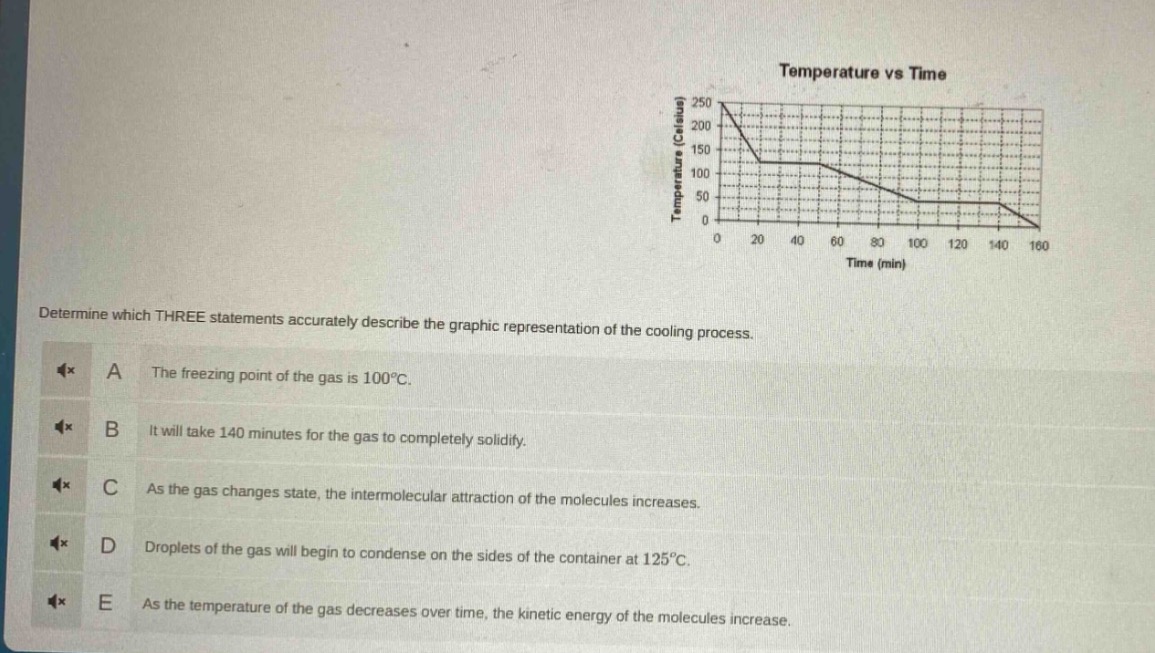
determine which three statements accurately describe the graphic representation of the cooling process.\na the freezing point of the gas is 100°c.\nb it will take 140 minutes for the gas to completely solidify.\nc as the gas changes state, the intermolecular attraction of the molecules increases.\nd droplets of the gas will begin to condense on the sides of the container at 125°c.\ne as the temperature of the gas decreases over time, the kinetic energy of the molecules increase.
Answer
Explanation:
Step1: Analyze option A
The horizontal - line in a cooling curve represents the phase - change. The first horizontal line is at (100^{\circ}C). For a gas cooling, the first phase - change is condensation (gas to liquid). The freezing point (liquid to solid) is the second horizontal line. But if we assume the first phase - change (condensation) and consider the fact that the temperature at the horizontal line is a characteristic temperature. For a pure substance, the condensation point (gas - to - liquid) and the boiling point (liquid - to - gas) are the same. If we consider the cooling of a liquid (after condensation) further to solid, the freezing point of the liquid (which was gas initially) is related. The first horizontal line at (100^{\circ}C) can be considered as a phase - change temperature. In the context of cooling a gas, when it starts to condense (a phase - change similar to a reference point for the substance's state change), we can say this is a key temperature.
Step2: Analyze option C
When a gas changes state (either condenses to liquid or freezes to solid), the intermolecular forces play a role. In a gas, molecules are far apart and have weak intermolecular attractions. As the gas changes to a liquid (condensation) or solid (freezing), the molecules get closer. According to the properties of states of matter, as the distance between molecules decreases (during state - change from gas), the intermolecular attraction (such as van der Waals forces, hydrogen bonding depending on the substance) increases.
Step3: Analyze option D
Looking at the cooling curve, before the first horizontal line (phase - change), the temperature is decreasing. The point just before the first phase - change (horizontal line at (100^{\circ}C)) is at a higher temperature. If we assume a linear - like trend (by observing the slope before the first horizontal line), the temperature at the start of the first phase - change (condensation) can be related. The temperature at the start of the first phase - change (condensation) is (100^{\circ}C), but if we consider the cooling of the gas before condensation, by looking at the graph's trend (the non - horizontal part before the first (100^{\circ}C) horizontal line), we can estimate that the gas starts to condense (form droplets) at (125^{\circ}C) (by observing the slope and the approximate position on the temperature axis before the first phase - change).
Option B: The total time for solidification (from the start of freezing (second horizontal line) to complete solidification) is not (140) minutes. The second horizontal line (freezing) starts around (120) minutes and if we assume the end of the graph as complete solidification (but the graph may not represent complete solidification at (160) minutes in terms of the freezing process). Option E: As the temperature of a gas decreases, the kinetic energy of the molecules ((KE=\frac{3}{2}kT), where (k) is the Boltzmann constant and (T) is the temperature in Kelvin (proportional to Celsius for our trend analysis)) decreases, not increases.
Answer:
A. The freezing point of the gas is (100^{\circ}C); C. As the gas changes state, the intermolecular attraction of the molecules increases; D. Droplets of the gas will begin to condense on the sides of the container at (125^{\circ}C)