the diagram above represents hydrogen gas (h₂) and nitrogen gas (n₂) in a closed container. if the reaction…
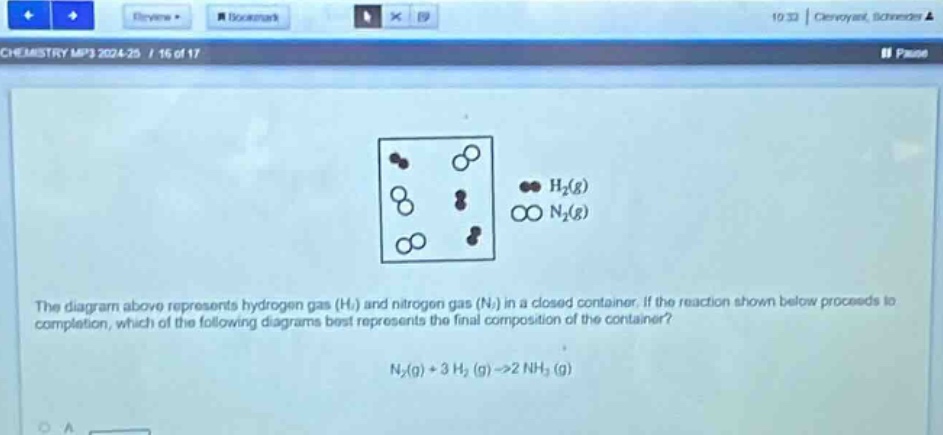
the diagram above represents hydrogen gas (h₂) and nitrogen gas (n₂) in a closed container. if the reaction shown below proceeds to completion, which of the following diagrams best represents the final composition of the container? n₂(g) + 3 h₂ (g) ->2 nh₃ (g)
Answer
Explanation:
Step1: Count initial molecules
From the diagram, there are 3 (H_2) molecules and 2 (N_2) molecules.
Step2: Determine limiting reactant
The reaction is (N_2(g)+3H_2(g)\rightarrow 2NH_3(g)). The mole - ratio of (N_2) to (H_2) is 1:3. For 3 (H_2) molecules, we need 1 (N_2) molecule. So (H_2) is the limiting reactant.
Step3: Calculate products and remaining reactants
3 (H_2) molecules will react with 1 (N_2) molecule to form 2 (NH_3) molecules. There will be (2 - 1=1) unreacted (N_2) molecule left.
Answer:
The final composition will have 2 (NH_3) molecules and 1 (N_2) molecule.