from the diagram, when the temperatures of reactants are raised from 20°c to 30°c:\nthe total number of…
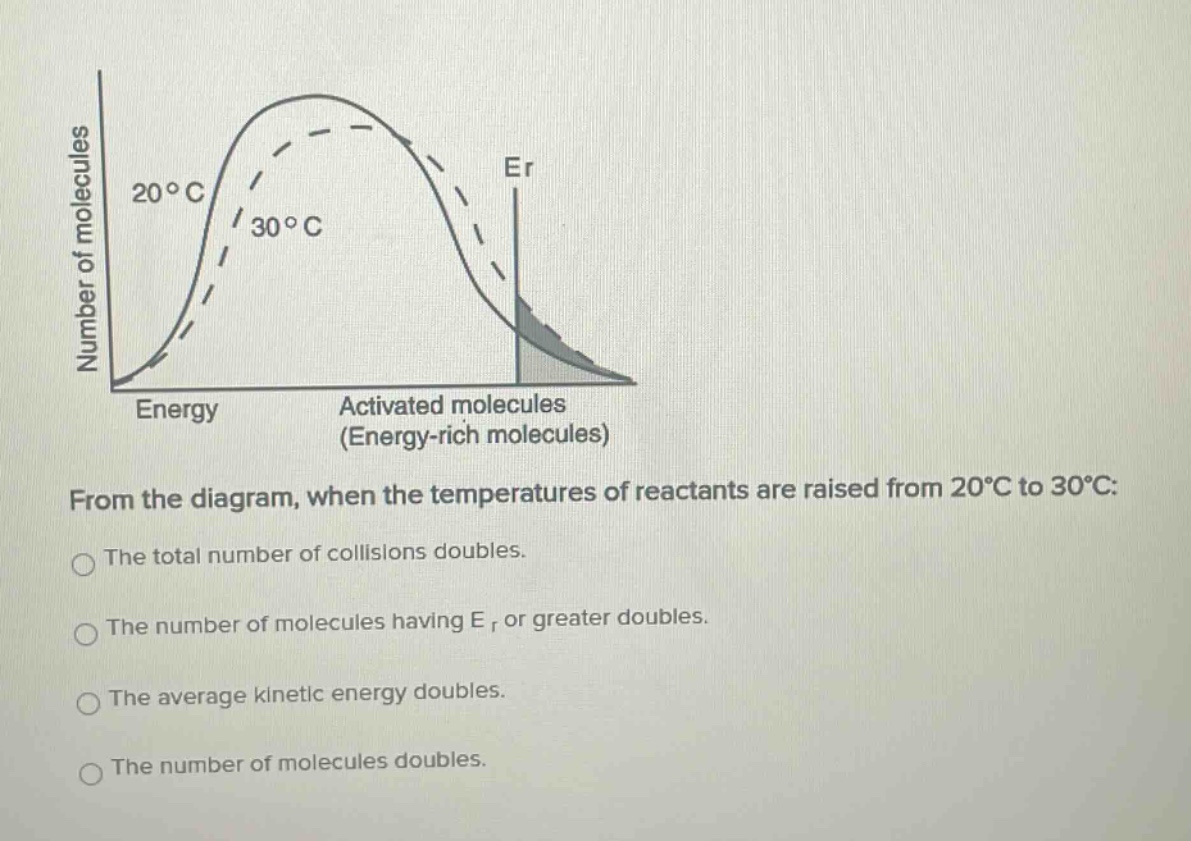
from the diagram, when the temperatures of reactants are raised from 20°c to 30°c:\nthe total number of collisions doubles.\nthe number of molecules having eᵣ or greater doubles.\nthe average kinetic energy doubles.\nthe number of molecules doubles.
Answer
Explanation:
Step1: Understand reaction - rate concept
Increasing temperature in a reaction system mainly affects the number of molecules with sufficient energy ($E_r$ or greater) to react.
Step2: Analyze each option
- The total number of collisions does not simply double with a 10 - degree temperature increase. Collision frequency is related to temperature but not in a simple doubling - relationship.
- When temperature increases from 20°C to 30°C, according to the Arrhenius concept and Maxwell - Boltzmann distribution, the number of molecules having the activation energy ($E_r$) or greater approximately doubles.
- The average kinetic energy of molecules is proportional to the temperature in Kelvin ($KE=\frac{3}{2}kT$). A 10 - degree increase from 20°C (293 K) to 30°C (303 K) does not double the average kinetic energy.
- The number of molecules in the system is determined by the amount of substance and is not affected by a small temperature change like this.
Answer:
The number of molecules having $E_r$ or greater doubles.