drag each image to the correct location on the model. each image can be used more than once. apply the rules…
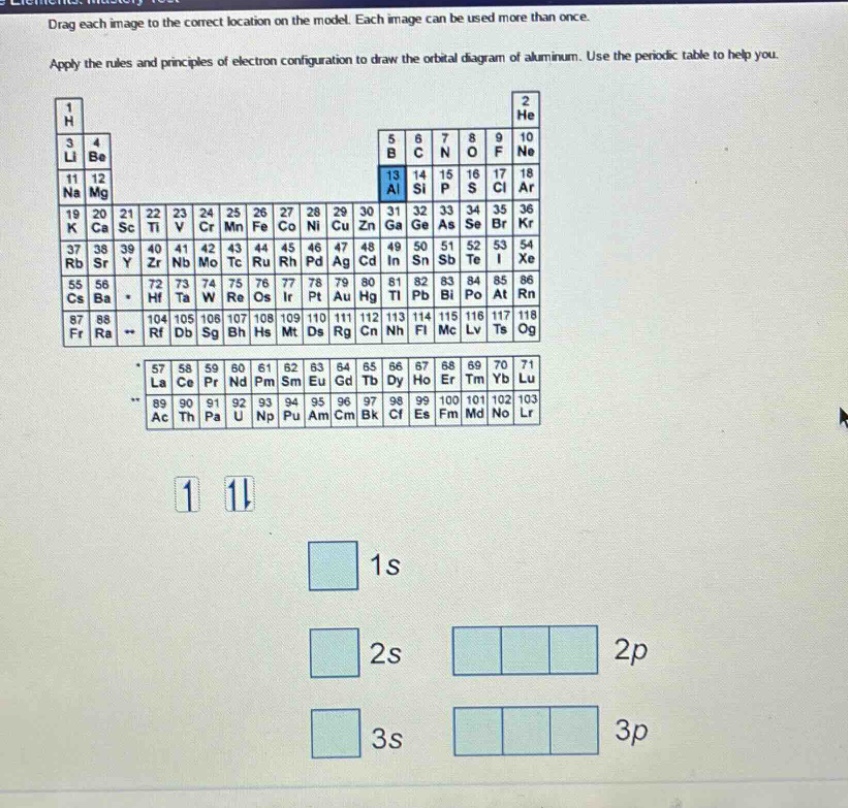
drag each image to the correct location on the model. each image can be used more than once. apply the rules and principles of electron - configuration to draw the orbital diagram of aluminum. use the periodic table to help you.
Answer
Explanation:
Step1: Determine atomic number of aluminum
Aluminum (Al) has an atomic number of 13, so it has 13 electrons.
Step2: Fill 1s orbital
The 1s orbital can hold 2 electrons. According to the Pauli - exclusion principle, the two electrons in 1s have opposite spins. So we put 2 electrons in the 1s box with opposite spins (↑↓).
Step3: Fill 2s orbital
The 2s orbital can also hold 2 electrons. We put 2 electrons in the 2s box with opposite spins (↑↓).
Step4: Fill 2p orbitals
The 2p sub - shell has 3 orbitals and can hold a total of 6 electrons. We fill the 2p orbitals one electron at a time (Hund's rule) before pairing them up. So we put 6 electrons in the 2p orbitals as ↑↓ ↑↓ ↑↓.
Step5: Fill 3s orbital
The 3s orbital can hold 2 electrons. We put 2 electrons in the 3s box with opposite spins (↑↓).
Step6: Fill 3p orbitals
After filling 1s, 2s, 2p and 3s, we have used 2 + 2+6 + 2=12 electrons. The remaining 1 electron goes into the 3p orbitals. According to Hund's rule, we put this single electron in one of the 3p orbitals with spin up (↑).
The orbital diagram for aluminum will have the 1s box with ↑↓, 2s box with ↑↓, 2p boxes with ↑↓ ↑↓ ↑↓, 3s box with ↑↓ and one of the 3p boxes with ↑.
Answer:
1s: ↑↓ 2s: ↑↓ 2p: ↑↓ ↑↓ ↑↓ 3s: ↑↓ 3p: ↑ (with the other two 3p boxes empty)