drag the ions together in such a way as to make a rectangle, from top down, in the \build model\ portion of…
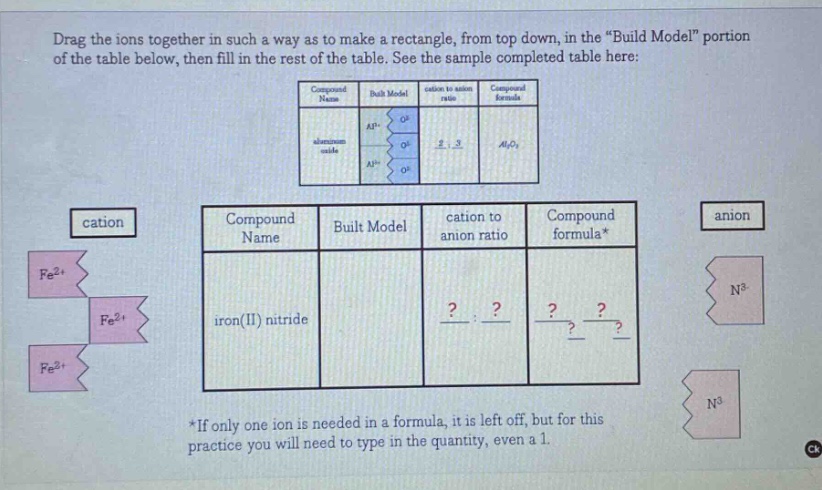
drag the ions together in such a way as to make a rectangle, from top down, in the \build model\ portion of the table below, then fill in the rest of the table. see the sample completed table here: *if only one ion is needed in a formula, it is left off, but for this practice you will need to type in the quantity, even a 1.
Answer
Explanation:
Step1: Determine charge - balance
The charge on iron(II) ion ($Fe^{2 + }$) is + 2 and the charge on nitride ion ($N^{3 - }$). To balance the charges, we use the least - common multiple of 2 and 3 which is 6.
Step2: Calculate ion ratios
For the positive charges to equal the negative charges, we need 3 iron(II) ions ($3\times( + 2)=+6$) and 2 nitride ions ($2\times(-3)= - 6$).
Step3: Write the ratio and formula
The cation to anion ratio is 3:2. The compound formula is $Fe_{3}N_{2}$.
Answer:
Cation to anion ratio: 3 : 2 Compound formula: $Fe_{3}N_{2}$