drag each label to the correct location on the equation. each label may be used more than once. identify the…
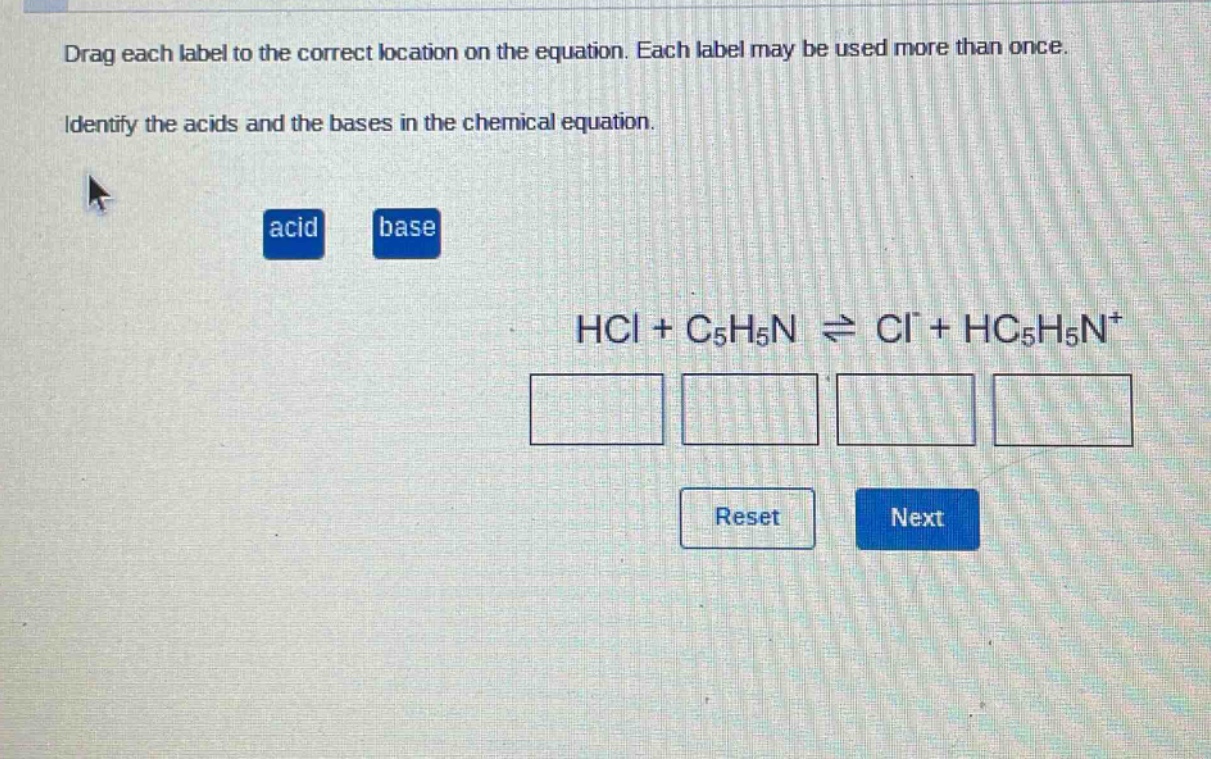
drag each label to the correct location on the equation. each label may be used more than once. identify the acids and the bases in the chemical equation. acid base hcl + c5h5n ⇌ cl⁻ + hc5h5n⁺ reset next
Answer
Explanation:
Step1: Recall acid - base definition
According to the Brønsted - Lowry theory, an acid is a proton donor and a base is a proton acceptor.
Step2: Analyze HCl
HCl donates a proton (H⁺) to form Cl⁻, so it is an acid.
Step3: Analyze C₅H₅N
C₅H₅N accepts a proton to form HC₅H₅N⁺, so it is a base.
Step4: Analyze Cl⁻
Cl⁻ is the conjugate base of HCl as it is formed after HCl donates a proton. It is not an acid or base in this forward - reaction context.
Step5: Analyze HC₅H₅N⁺
HC₅H₅N⁺ is the conjugate acid of C₅H₅N as it is formed after C₅H₅N accepts a proton. It is not an acid or base in this forward - reaction context.
Answer:
acid, base, ,