drag the tiles to the boxes to form correct pairs. match each chemical reaction with the type of reaction…
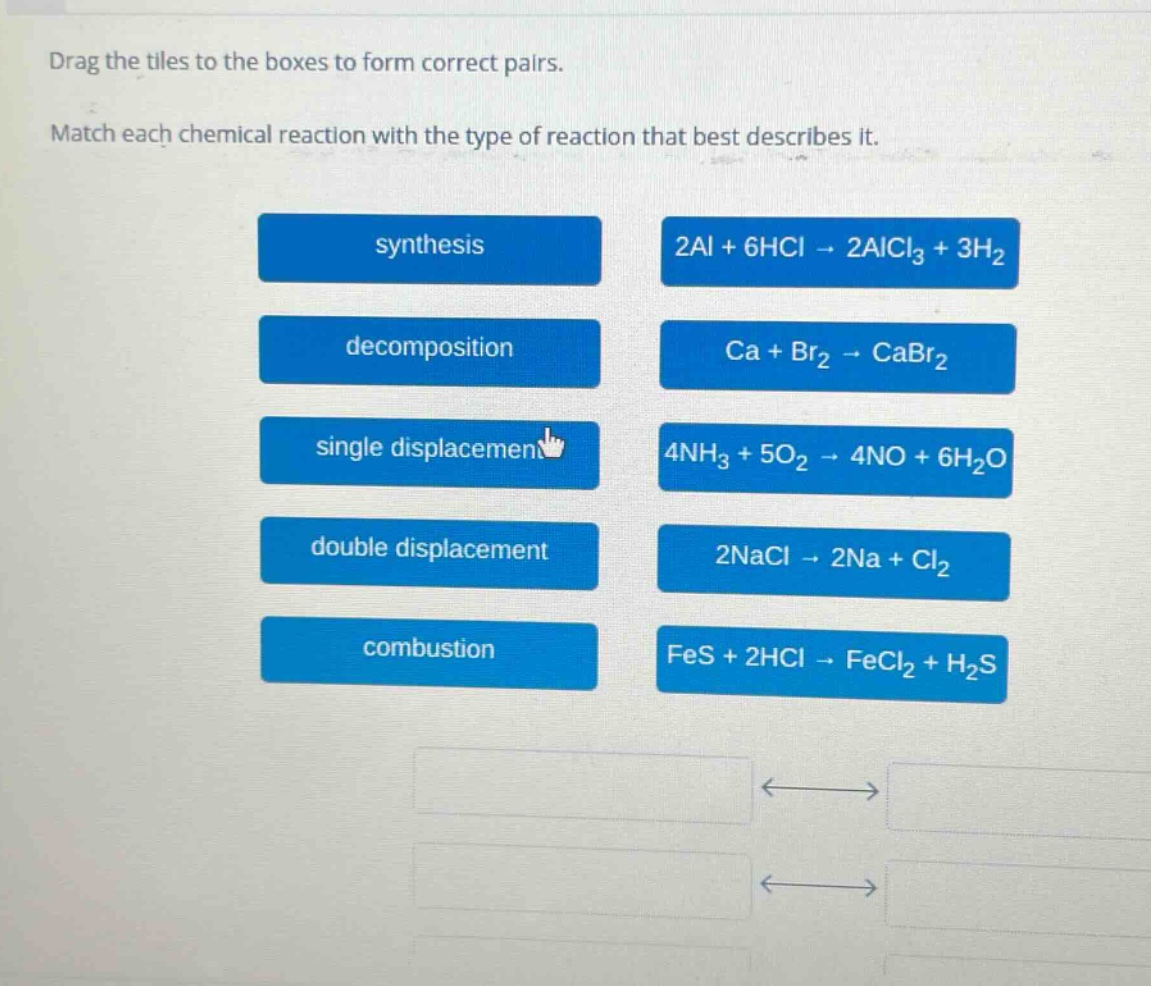
drag the tiles to the boxes to form correct pairs. match each chemical reaction with the type of reaction that best describes it. synthesis 2al + 6hcl → 2alcl₃ + 3h₂ decomposition ca + br₂ → cabr₂ single displacement 4nh₃ + 5o₂ → 4no + 6h₂o double displacement 2nacl → 2na + cl₂ combustion fes + 2hcl → fecl₂ + h₂s
Answer
Answer:
synthesis - $Ca + Br_2\rightarrow CaBr_2$ decomposition - $2NaCl\rightarrow 2Na + Cl_2$ single displacement - $2Al + 6HCl\rightarrow 2AlCl_3+3H_2$, $FeS + 2HCl\rightarrow FeCl_2 + H_2S$ combustion - $4NH_3 + 5O_2\rightarrow 4NO + 6H_2O$
Explanation:
Step1: Identify synthesis reaction
A synthesis reaction combines two or more substances into one. $Ca + Br_2\rightarrow CaBr_2$ has two elements combining to form a compound.
Step2: Identify decomposition reaction
A decomposition reaction breaks a compound into two or more simpler substances. $2NaCl\rightarrow 2Na + Cl_2$ is a compound splitting into elements.
Step3: Identify single - displacement reaction
In a single - displacement reaction, one element replaces another in a compound. In $2Al + 6HCl\rightarrow 2AlCl_3+3H_2$, Al replaces H in HCl, and in $FeS + 2HCl\rightarrow FeCl_2 + H_2S$, H replaces S in FeS.
Step4: Identify combustion reaction
A combustion reaction involves a substance reacting with oxygen. $4NH_3 + 5O_2\rightarrow 4NO + 6H_2O$ is ammonia reacting with oxygen.