drag the tiles to the correct boxes to complete the pairs. chromium is a transition metal, and oxygen has an…
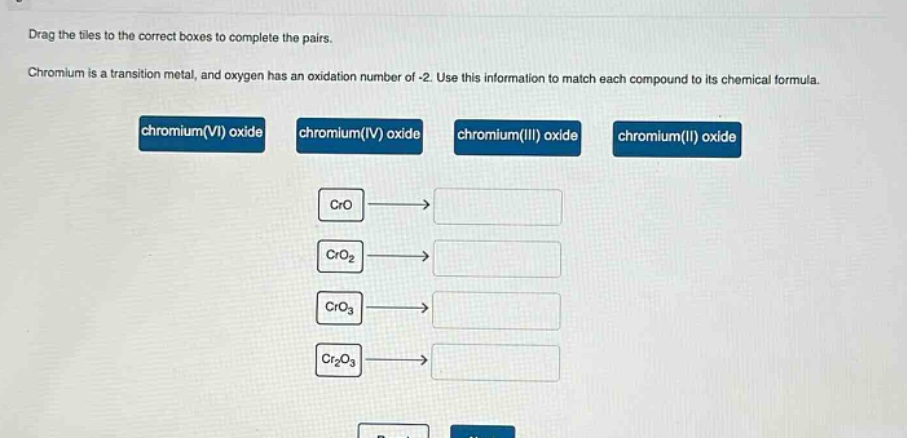
drag the tiles to the correct boxes to complete the pairs. chromium is a transition metal, and oxygen has an oxidation number of -2. use this information to match each compound to its chemical formula. chromium(vi) oxide chromium(iv) oxide chromium(iii) oxide chromium(ii) oxide cro cro2 cro3 cr2o3
Answer
Answer:
- CrO → chromium(II) oxide
- CrO₂ → chromium(IV) oxide
- CrO₃ → chromium(VI) oxide
- Cr₂O₃ → chromium(III) oxide
Explanation:
Step1: Determine oxidation - state balance
In a compound, the sum of oxidation numbers of all atoms is zero. For CrO, let the oxidation number of Cr be (x). Oxygen has an oxidation number of - 2. So (x+( - 2)=0), then (x = + 2), which is chromium(II) oxide.
Step2: For CrO₂
Let the oxidation number of Cr be (x). There are 2 oxygen atoms each with an oxidation number of - 2. So (x+2\times(-2)=0), (x - 4 = 0), (x=+4), which is chromium(IV) oxide.
Step3: For CrO₃
Let the oxidation number of Cr be (x). There are 3 oxygen atoms each with an oxidation number of - 2. So (x + 3\times(-2)=0), (x-6 = 0), (x = + 6), which is chromium(VI) oxide.
Step4: For Cr₂O₃
Let the oxidation number of Cr be (x). There are 2 Cr atoms and 3 oxygen atoms with an oxidation number of - 2. So (2x+3\times(-2)=0), (2x-6 = 0), (2x=6), (x = + 3), which is chromium(III) oxide.