5) draw a lewis diagram of pentane. hint: bond the 5 carbon atoms in a row first. 6) is pentane a polar…
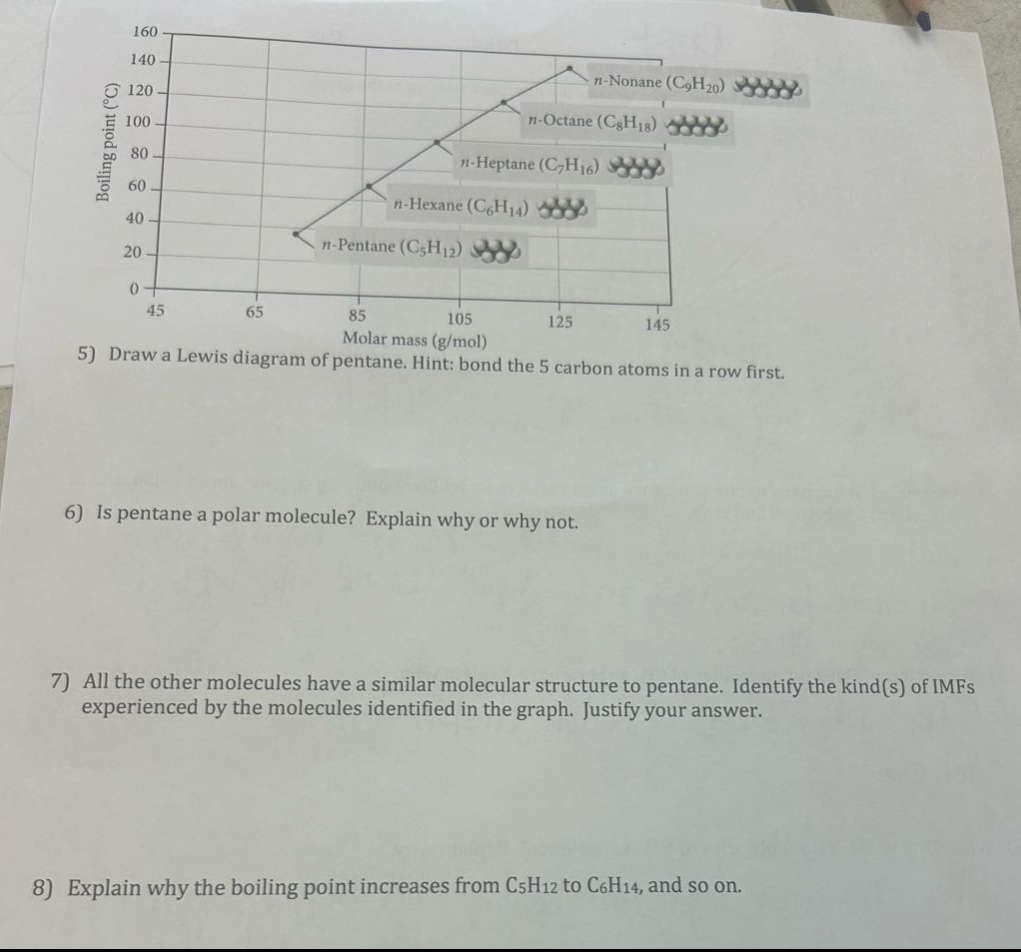
5) draw a lewis diagram of pentane. hint: bond the 5 carbon atoms in a row first. 6) is pentane a polar molecule? explain why or why not. 7) all the other molecules have a similar molecular structure to pentane. identify the kind(s) of imfs experienced by the molecules identified in the graph. justify your answer. 8) explain why the boiling point increases from c5h12 to c6h14, and so on.
Answer
5)
Explanation:
Step1: Determine valence - electrons
Carbon has 4 valence - electrons and hydrogen has 1. For $C_5H_{12}$, total valence - electrons = $5\times4 + 12\times1=32$.
Step2: Bond carbon atoms
Draw 5 carbon atoms in a row and connect them with single bonds ($C - C - C - C - C$). This uses $4\times2 = 8$ electrons for the carbon - carbon bonds.
Step3: Add hydrogen atoms
Each carbon atom needs to have 4 bonds. The terminal carbons need 3 hydrogen atoms each and the middle carbons need 2 hydrogen atoms each. So, we have the Lewis structure:
  H  H  H  H  H
  |  |  |  |  |
H - C - C - C - C - C - H
  |  |  |  |  |
  H  H  H  H  H
6)
Brief Explanations:
The electronegativity of carbon is 2.5 and that of hydrogen is 2.1. The $C - H$ bonds are slightly polar, but due to the symmetrical tetrahedral geometry around each carbon atom and the overall symmetrical structure of pentane, the bond dipoles cancel out. So, pentane is a non - polar molecule.
Answer:
No, pentane is not a polar molecule because the bond dipoles cancel out due to its symmetrical structure.
7)
Brief Explanations:
The molecules in the graph are non - polar hydrocarbons (alkanes). The only intermolecular forces (IMFs) experienced by non - polar molecules are London dispersion forces. These forces arise from temporary dipoles created by the motion of electrons in the molecules. Larger molecules have more electrons, so they have stronger London dispersion forces.
Answer:
London dispersion forces. Non - polar molecules like alkanes only have London dispersion forces due to temporary electron - induced dipoles.
8)
Brief Explanations:
As the molar mass increases from $C_5H_{12}$ to $C_6H_{14}$ and so on, the number of electrons in the molecule increases. Since London dispersion forces are proportional to the number of electrons, larger molecules have stronger London dispersion forces. Stronger intermolecular forces require more energy to break, so the boiling point increases.
Answer:
The boiling point increases because as the molar mass increases, the number of electrons increases, leading to stronger London dispersion forces which require more energy to overcome.