the drawing below shows a mixture of molecules: key carbon hydrogen nitrogen sulfur oxygen chlorine suppose…
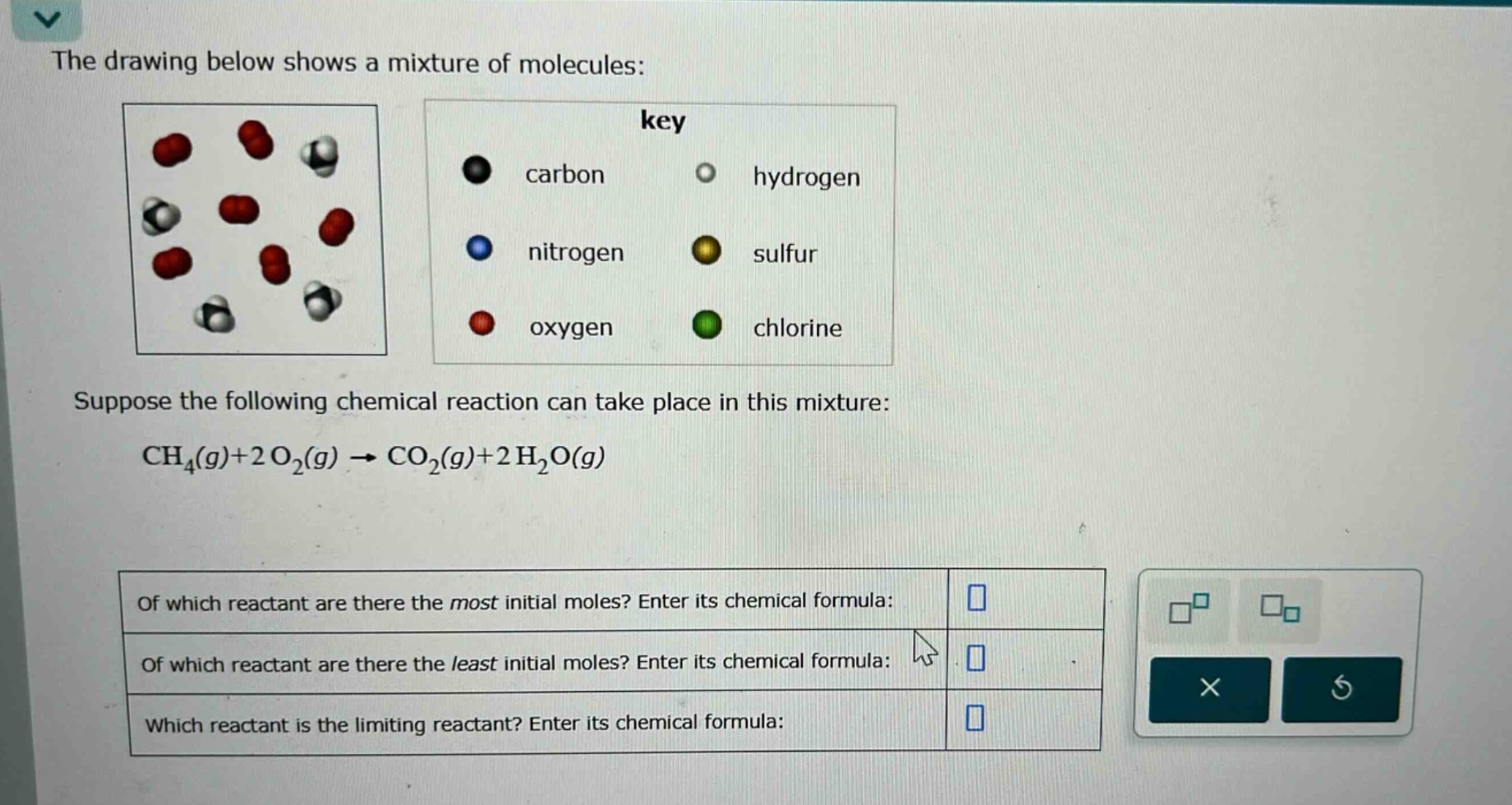
the drawing below shows a mixture of molecules: key carbon hydrogen nitrogen sulfur oxygen chlorine suppose the following chemical reaction can take place in this mixture: ch₄(g)+2o₂(g)→co₂(g)+2h₂o(g) of which reactant are there the most initial moles? enter its chemical formula: of which reactant are there the least initial moles? enter its chemical formula: which reactant is the limiting reactant? enter its chemical formula:
Answer
Explanation:
Step1: Count reactant molecules
Count the number of $\text{CH}_4$ and $\text{O}_2$ molecules in the mixture. Assume each molecule represents 1 mole for simplicity of comparison.
Step2: Determine most - moles reactant
Compare the counts. If there are more $\text{O}_2$ molecules than $\text{CH}_4$ molecules, $\text{O}_2$ has the most initial moles.
Step3: Determine least - moles reactant
If $\text{CH}_4$ molecules are fewer in number compared to $\text{O}_2$ molecules, $\text{CH}_4$ has the least initial moles.
Step4: Identify limiting reactant
Use the stoichiometry of the reaction $\text{CH}_4(g)+2\text{O}_2(g)\to\text{CO}_2(g) + 2\text{H}_2\text{O}(g)$. Calculate the amount of product that can be formed from each reactant. The reactant that produces the least amount of product is the limiting reactant. If the mole - ratio of $\text{CH}_4$ to $\text{O}_2$ is 1:2 in the reaction, and there is not enough $\text{CH}_4$ relative to $\text{O}_2$ based on this ratio, $\text{CH}_4$ is the limiting reactant.
Answer:
- $\text{O}_2$
- $\text{CH}_4$
- $\text{CH}_4$