due to hydrogen bonding, liquid water and ice have different densities. during the winter, water on the…
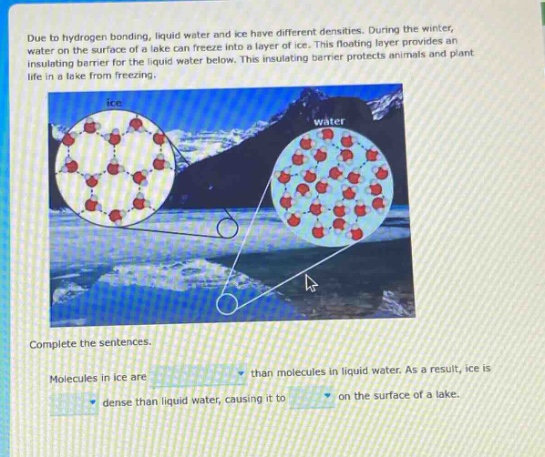
due to hydrogen bonding, liquid water and ice have different densities. during the winter, water on the surface of a lake can freeze into a layer of ice. this floating layer provides an insulating barrier for the liquid water below. this insulating barrier protects animals and plant life in a lake from freezing. complete the sentences. molecules in ice are than molecules in liquid water. as a result, ice is dense than liquid water, causing it to on the surface of a lake.
Answer
Explanation:
Step1: Understand hydrogen - bonding effect
Hydrogen bonding in ice causes molecules to be more spread out.
Step2: Determine density relationship
Since ice molecules are more spread - out, ice is less dense than liquid water.
Step3: Identify floating property
Less dense substances float on more dense substances, so ice floats on the surface of a lake.
Answer:
more spread out; less; float