elements are organized on the periodic table based on their properties. which statement correctly predicts…
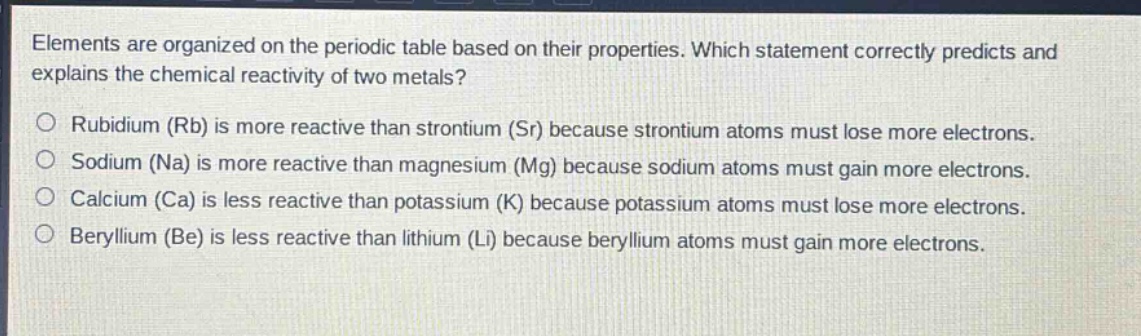
elements are organized on the periodic table based on their properties. which statement correctly predicts and explains the chemical reactivity of two metals?\no rubidium (rb) is more reactive than strontium (sr) because strontium atoms must lose more electrons.\no sodium (na) is more reactive than magnesium (mg) because sodium atoms must gain more electrons.\no calcium (ca) is less reactive than potassium (k) because potassium atoms must lose more electrons.\no beryllium (be) is less reactive than lithium (li) because beryllium atoms must gain more electrons.
Answer
Brief Explanations:
- In the periodic table, for metals in the same period, reactivity increases as we move from right - to - left. This is because metals tend to lose electrons in chemical reactions. The fewer electrons a metal has to lose to achieve a stable electron configuration, the more reactive it is.
- Rubidium (Rb) is in Group 1 and Strontium (Sr) is in Group 2. Rubidium needs to lose 1 electron to have a stable configuration, while strontium needs to lose 2 electrons. So, rubidium is more reactive.
- Sodium (Na) and magnesium (Mg) are metals and they lose electrons, not gain electrons in reactions, so the statement about sodium gaining electrons is incorrect.
- Potassium (K) needs to lose 1 electron and calcium (Ca) needs to lose 2 electrons. Potassium is more reactive than calcium, but the reason given about potassium losing more electrons is wrong as potassium loses fewer electrons.
- Beryllium (Be) and lithium (Li) are metals and they lose electrons, not gain electrons in reactions, so the statement about beryllium gaining electrons is incorrect.
Answer:
Rubidium (Rb) is more reactive than strontium (Sr) because strontium atoms must lose more electrons.