what is the empirical formula for a compound if a sample contains 3.72 g of p and 21.28 g of…
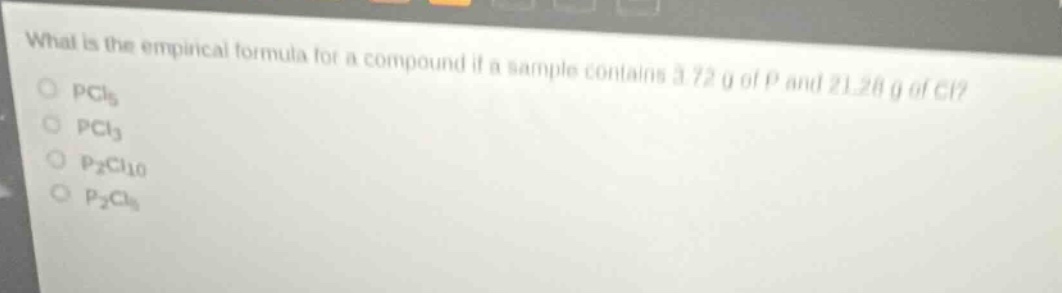
what is the empirical formula for a compound if a sample contains 3.72 g of p and 21.28 g of cl?\npcl₅\npcl₃\np₂cl₁₀\np₂cl₅
Answer
Explanation:
Step1: Calculate moles of P
Use the formula $n=\frac{m}{M}$, where $n$ is moles, $m$ is mass, and $M$ is molar - mass. The molar mass of $P$ is $M_P = 30.97\ g/mol$. Given $m_P=3.72\ g$, then $n_P=\frac{3.72\ g}{30.97\ g/mol}\approx0.12\ mol$.
Step2: Calculate moles of Cl
The molar mass of $Cl$ is $M_{Cl}=35.45\ g/mol$. Given $m_{Cl}=21.28\ g$, then $n_{Cl}=\frac{21.28\ g}{35.45\ g/mol}\approx0.6\ mol$.
Step3: Find the mole - ratio
Divide the number of moles of each element by the smaller number of moles. For $P$ and $Cl$, divide by $n_P = 0.12\ mol$. $\frac{n_{Cl}}{n_P}=\frac{0.6\ mol}{0.12\ mol}=5$ and $\frac{n_P}{n_P} = 1$. So the empirical formula is $PCl_5$.
Answer:
A. $PCl_5$