how should the enthalpy of an intermediate step be manipulated when used to produce an overall chemical…
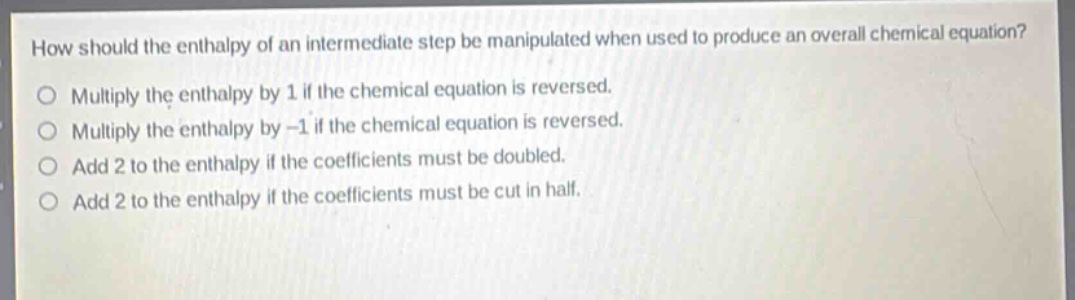
how should the enthalpy of an intermediate step be manipulated when used to produce an overall chemical equation?\nmultiply the enthalpy by 1 if the chemical equation is reversed.\nmultiply the enthalpy by -1 if the chemical equation is reversed.\nadd 2 to the enthalpy if the coefficients must be doubled.\nadd 2 to the enthalpy if the coefficients must be cut in half.
Answer
Brief Explanations:
According to Hess's law, when a chemical - equation is reversed, the sign of the enthalpy change is reversed, which means multiplying the enthalpy by - 1. Changing the coefficients of a chemical equation scales the enthalpy change proportionally, but adding 2 to the enthalpy for doubling or halving coefficients is incorrect.
Answer:
Multiply the enthalpy by -1 if the chemical equation is reversed.