how is enthalpy used to predict whether a reaction is endothermic or exothermic?\nwhen the enthalpy of the…
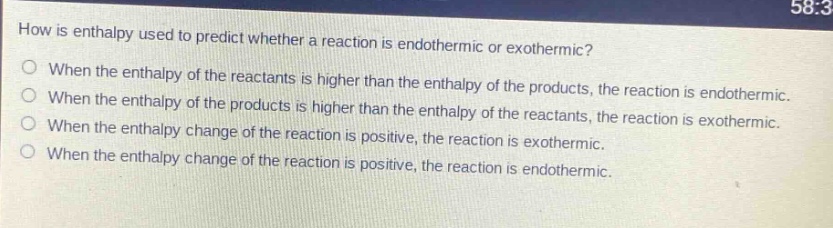
how is enthalpy used to predict whether a reaction is endothermic or exothermic?\nwhen the enthalpy of the reactants is higher than the enthalpy of the products, the reaction is endothermic.\nwhen the enthalpy of the products is higher than the enthalpy of the reactants, the reaction is exothermic.\nwhen the enthalpy change of the reaction is positive, the reaction is exothermic.\nwhen the enthalpy change of the reaction is positive, the reaction is endothermic.
Answer
Brief Explanations:
Enthalpy change ($\Delta H$) is calculated as $\Delta H=H_{products}-H_{reactants}$. In an endothermic reaction, heat is absorbed, so $\Delta H> 0$, meaning the enthalpy of products is higher than that of reactants. In an exothermic reaction, heat is released, so $\Delta H < 0$, meaning the enthalpy of products is lower than that of reactants.
Answer:
When the enthalpy change of the reaction is positive, the reaction is endothermic.