this is the equation for the dissociation of ammonia gas at 293 k. δh = 145 kj and δs = 195 j/k. 2nh3(g) →…
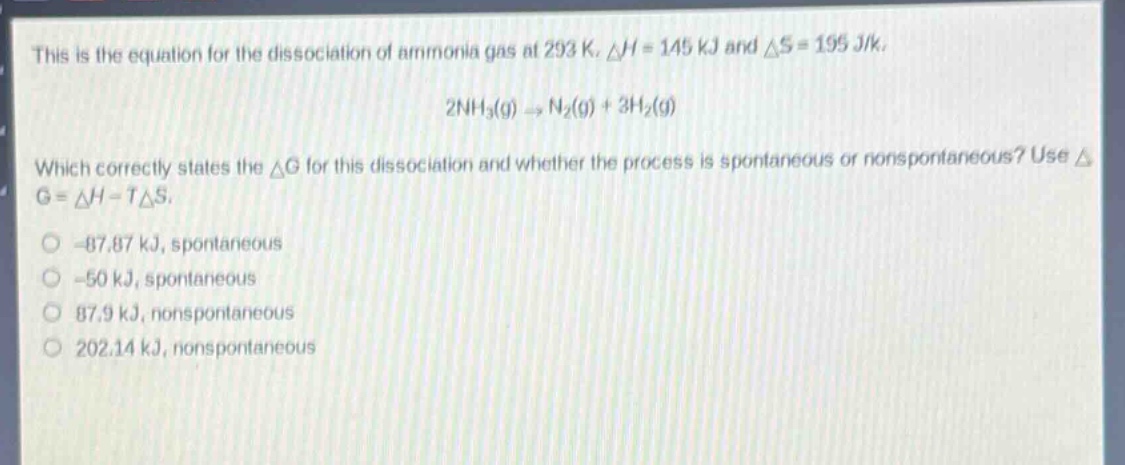
this is the equation for the dissociation of ammonia gas at 293 k. δh = 145 kj and δs = 195 j/k. 2nh3(g) → n2(g) + 3h2(g) which correctly states the δg for this dissociation and whether the process is spontaneous or nonspontaneous? use δg = δh - tδs. -87.87 kj, spontaneous -50 kj, spontaneous 87.9 kj, nonspontaneous 202.14 kj, nonspontaneous
Answer
Answer:
C. 87.9 kJ, non - spontaneous
Explanation:
Step1: Convert la entropía a kJ/K
$\Delta S = 195\ J/K=0.195\ kJ/K$
Step2: Aplicar la fórmula $\Delta G=\Delta H - T\Delta S$
$\Delta G = 145\ kJ-(293\ K\times0.195\ kJ/K)$ $\Delta G = 145\ kJ - 57.135\ kJ$ $\Delta G = 87.865\ kJ\approx87.9\ kJ$
Step3: Determinar la espontaneidad
Como $\Delta G> 0$, el proceso es no espontáneo.