which equation has both a liquid and a gas as products?\no 2hgo(s)→2hg(l)+o2(g)\no 2mg(s)+o2(g)→2mgo(s)\no…
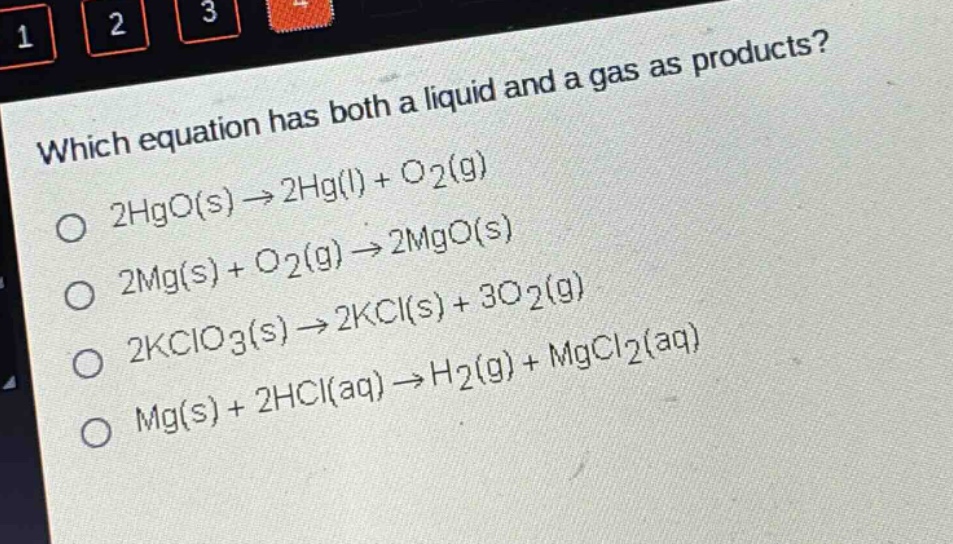
which equation has both a liquid and a gas as products?\no 2hgo(s)→2hg(l)+o2(g)\no 2mg(s)+o2(g)→2mgo(s)\no 2kclo3(s)→2kcl(s)+3o2(g)\no mg(s)+2hcl(aq)→h2(g)+mgcl2(aq)
Answer
Explanation:
Step1: Analyze first equation
The reaction $2HgO(s)\rightarrow2Hg(l)+O_2(g)$ has mercury in liquid - state ($Hg(l)$) and oxygen in gaseous - state ($O_2(g)$) as products.
Step2: Analyze second equation
The reaction $2Mg(s)+O_2(g)\rightarrow2MgO(s)$ has only solid magnesium oxide ($MgO(s)$) as a product.
Step3: Analyze third equation
The reaction $2KClO_3(s)\rightarrow2KCl(s)+3O_2(g)$ has solid potassium chloride ($KCl(s)$) and gaseous oxygen ($O_2(g)$) as products, but no liquid product.
Step4: Analyze fourth equation
The reaction $Mg(s)+2HCl(aq)\rightarrow H_2(g)+MgCl_2(aq)$ has gaseous hydrogen ($H_2(g)$) and an aqueous solution of magnesium chloride ($MgCl_2(aq)$), but no liquid product in the pure sense.
Answer:
$2HgO(s)\rightarrow2Hg(l)+O_2(g)$