the equation below shows a general equation for a reaction, and the amounts of the substance are written…
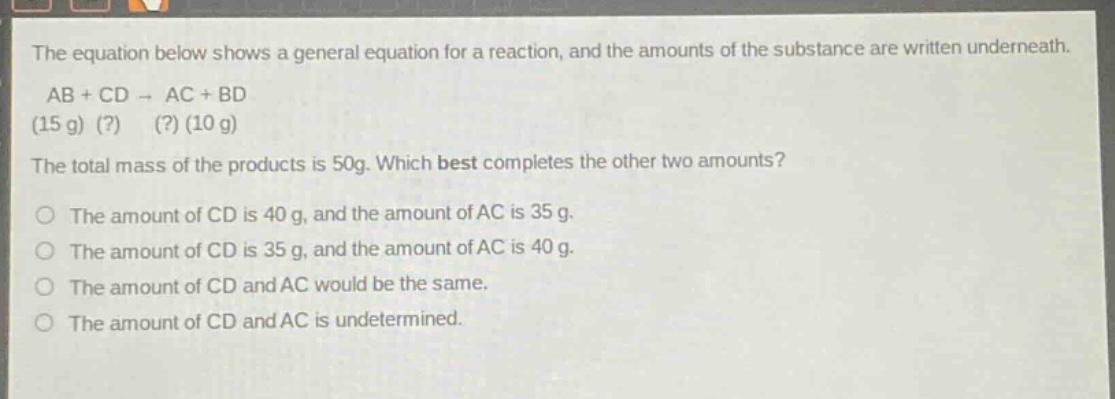
the equation below shows a general equation for a reaction, and the amounts of the substance are written underneath. ab + cd → ac + bd (15 g) (?) (?) (10 g) the total mass of the products is 50g. which best completes the other two amounts? the amount of cd is 40 g, and the amount of ac is 35 g. the amount of cd is 35 g, and the amount of ac is 40 g. the amount of cd and ac would be the same. the amount of cd and ac is undetermined.
Answer
Explanation:
Step1: Apply law of conservation of mass
According to the law of conservation of mass, the total mass of reactants equals the total mass of products. The total mass of products is 50 g. One reactant AB has a mass of 15 g and one product BD has a mass of 10 g. Let the mass of CD be $x$ and the mass of AC be $y$. So, $15 + x=y + 10=50$.
Step2: Calculate the mass of CD
We know that the sum of reactants' masses is 50 g. Since one reactant AB is 15 g, then the mass of CD is $50 - 15=35$ g.
Step3: Calculate the mass of AC
We know that the sum of products' masses is 50 g. Since one product BD is 10 g, then the mass of AC is $50 - 10 = 40$ g.
Answer:
The amount of CD is 35 g, and the amount of AC is 40 g.