ethene will not typically react with hydrogen gas through simple bimolecular collisions. using the picture…
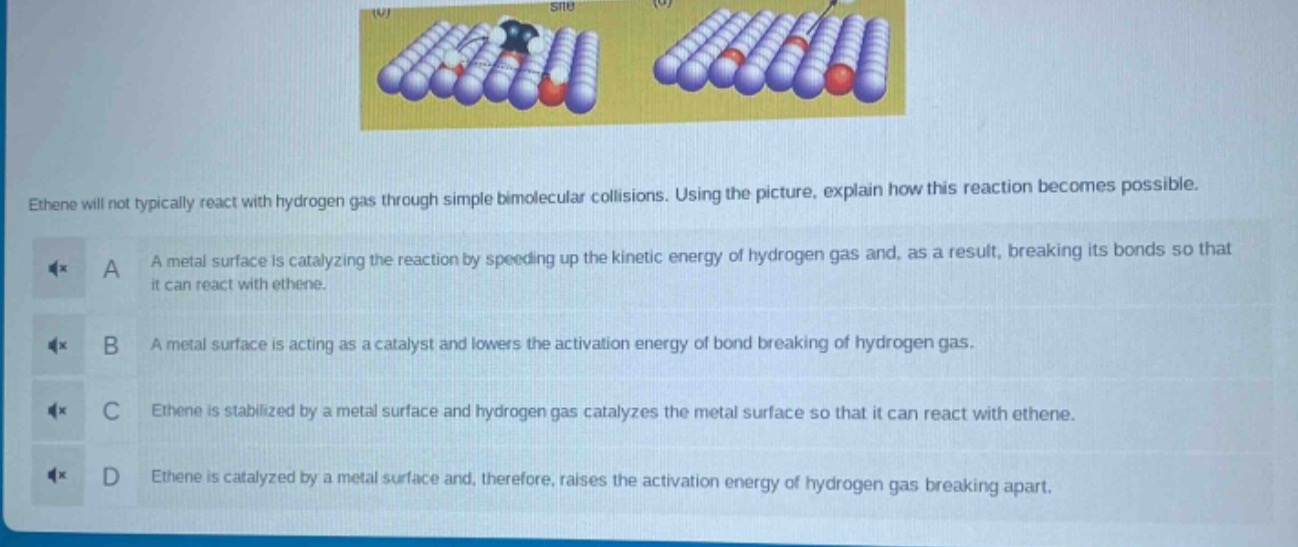
ethene will not typically react with hydrogen gas through simple bimolecular collisions. using the picture, explain how this reaction becomes possible.\na a metal surface is catalyzing the reaction by speeding up the kinetic energy of hydrogen gas and, as a result, breaking its bonds so that it can react with ethene.\nb a metal surface is acting as a catalyst and lowers the activation energy of bond breaking of hydrogen gas.\nc ethene is stabilized by a metal surface and hydrogen gas catalyzes the metal surface so that it can react with ethene.\nd ethene is catalyzed by a metal surface and, therefore, raises the activation energy of hydrogen gas breaking apart.
Answer
Brief Explanations:
Catalysts lower activation energy for reactions. Here, the metal surface acts as a catalyst for the reaction between ethene and hydrogen gas. It helps in breaking the bonds of hydrogen gas by reducing the energy barrier required for the reaction to occur. Option A is wrong as it's not about speeding up kinetic energy to break bonds. Option C has the wrong direction of catalysis - hydrogen gas isn't catalyzing the metal surface. Option D is incorrect because a catalyst lowers, not raises, activation energy.
Answer:
B. A metal surface is acting as a catalyst and lowers the activation energy of bond breaking of hydrogen gas.