ethyne (c2h2(g), △hf = 226.77 kj/mol) undergoes complete combustion in the presence of oxygen to produce…
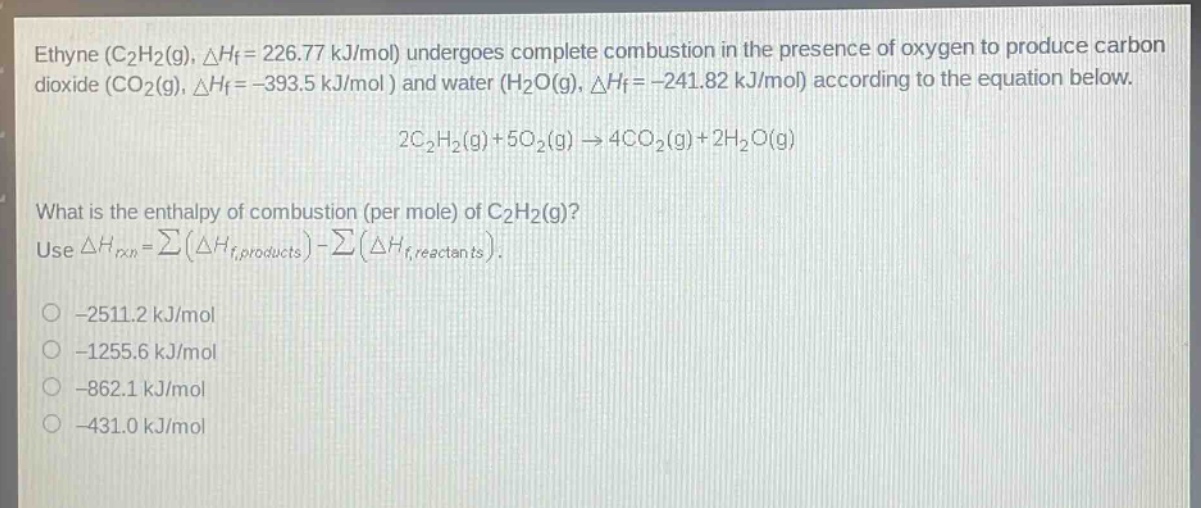
ethyne (c2h2(g), △hf = 226.77 kj/mol) undergoes complete combustion in the presence of oxygen to produce carbon dioxide (co2(g), △hf = -393.5 kj/mol ) and water (h2o(g), △hf = -241.82 kj/mol) according to the equation below. 2c2h2(g)+5o2(g)→4co2(g)+2h2o(g) what is the enthalpy of combustion (per mole) of c2h2(g)? use △hrxn=∑(△hf,products) - ∑(△hf,reactants). -2511.2 kj/mol -1255.6 kj/mol -862.1 kj/mol -431.0 kj/mol
Answer
Explanation:
Step1: Calculate sum of $\Delta H_f$ for products
The products are $4$ moles of $CO_2$ and $2$ moles of $H_2O$. $\sum(\Delta H_{f,products})=4\times(- 393.5)+2\times(-241.82)$ $=-1574 - 483.64=-2057.64$ kJ/mol
Step2: Calculate sum of $\Delta H_f$ for reactants
The reactants are $2$ moles of $C_2H_2$ and $5$ moles of $O_2$ (the $\Delta H_f$ of $O_2$ is $0$ kJ/mol). $\sum(\Delta H_{f,reactants})=2\times226.77+5\times0 = 453.54$ kJ/mol
Step3: Calculate $\Delta H_{rxn}$
Using $\Delta H_{rxn}=\sum(\Delta H_{f,products})-\sum(\Delta H_{f,reactants})$, we have: $\Delta H_{rxn}=-2057.64 - 453.54=-2511.18\approx - 2511.2$ kJ/mol for $2$ moles of $C_2H_2$.
Step4: Find $\Delta H$ per mole of $C_2H_2$
$\Delta H$ per mole of $C_2H_2=\frac{-2511.2}{2}=-1255.6$ kJ/mol
Answer:
-1255.6 kJ/mol