event or processes\ttimeframe (millions of years ago)\tatmosphere and composition\ninitial formation of…
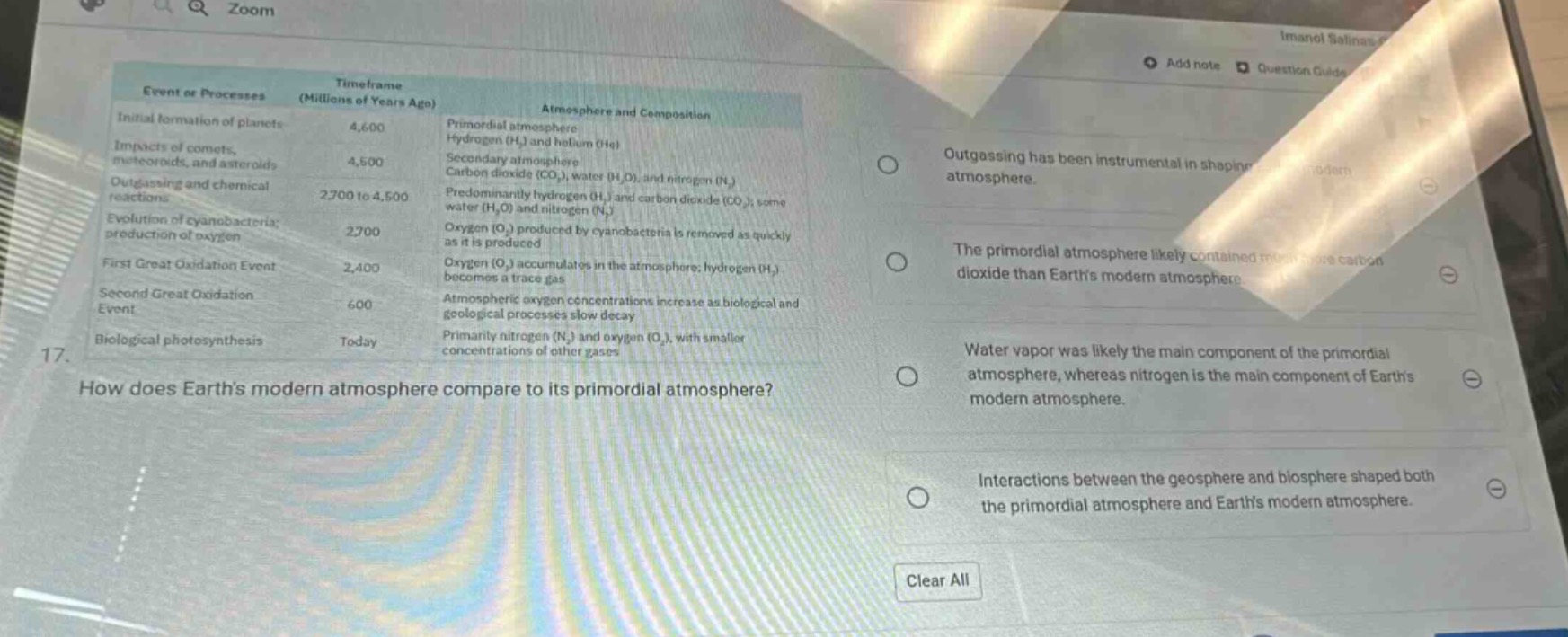
event or processes\ttimeframe (millions of years ago)\tatmosphere and composition\ninitial formation of planets\t4,600\tprimordial atmosphere: hydrogen (h₂) and helium (he)\nimpacts of comets, meteoroids, and asteroids\t4,500\tsecondary atmosphere: carbon dioxide (co₂), water (h₂o), and nitrogen (n₂)\noutgassing and chemical reactions\t2,700 to 4,500\tpredominantly hydrogen (h₂) and carbon dioxide (co₂), some water (h₂o) and nitrogen (n₂)\nevolution of cyanobacteria: production of oxygen\t2,700\toxygen (o₂) produced by cyanobacteria is removed as quickly as it is produced\nfirst great oxidation event\t2,400\toxygen (o₂) accumulates in the atmosphere; hydrogen (h₂) becomes a trace gas\nsecond great oxidation event\t600\tatmospheric oxygen concentrations increase as biological and geological processes slow decay\nbiological photosynthesis\ttoday\tprimarily nitrogen (n₂) and oxygen (o₂), with smaller concentrations of other gases\n17. how does earth’s modern atmosphere compare to its primordial atmosphere?\noutgassing has been instrumental in shaping atmosphere.\nthe primordial atmosphere likely contained more carbon dioxide than earth’s modern atmosphere.\nwater vapor was likely the main component of the primordial atmosphere, whereas nitrogen is the main component of earth’s modern atmosphere.\ninteractions between the geosphere and biosphere shaped both the primordial atmosphere and earth’s modern atmosphere.
Answer
Answer:
Interactions between the geosphere and biosphere shaped both the primordial atmosphere and Earth's modern atmosphere.
Brief Explanation:
Over time, geological and biological processes have transformed the atmosphere. Outgassing, chemical reactions, and the evolution of cyanobacteria are examples of such processes that have been influenced by geosphere - biosphere interactions.