which is an example of ionization?\nc + o₂ → co₂\nh₂co₃ → h₂o + co₂\nso₂ + h₂o → hso₃⁻ + h⁺\nmg(oh)₂ → mg²⁺…
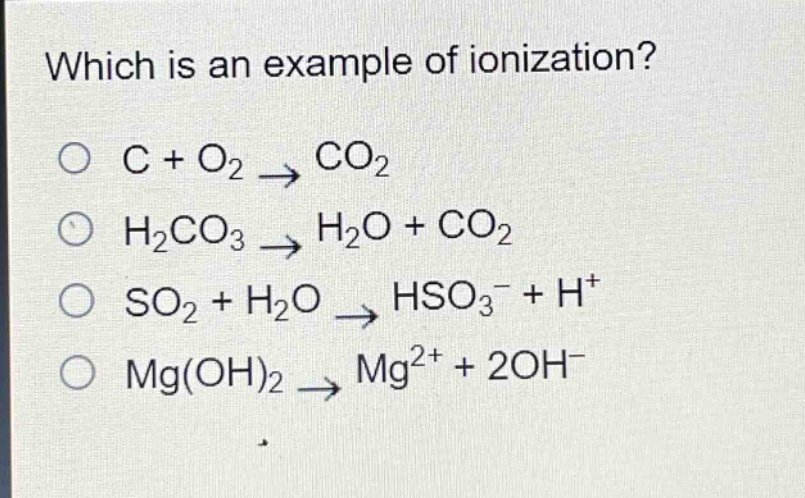
which is an example of ionization?\nc + o₂ → co₂\nh₂co₃ → h₂o + co₂\nso₂ + h₂o → hso₃⁻ + h⁺\nmg(oh)₂ → mg²⁺ + 2oh⁻
Answer
Brief Explanations:
Ionization is the process by which an atom or molecule gains or loses electrons to form ions. In the reaction $\text{Mg(OH)}_2\rightarrow\text{Mg}^{2 +}+2\text{OH}^-$, the magnesium - hydroxide compound dissociates into magnesium cations ($\text{Mg}^{2 +}$) and hydroxide anions ($\text{OH}^-$). This is an example of ionization as neutral $\text{Mg(OH)}_2$ breaks into charged species. The other reactions are not ionization reactions: $\text{C}+\text{O}_2\rightarrow\text{CO}_2$ is a combustion reaction, $\text{H}_2\text{CO}_3\rightarrow\text{H}_2\text{O}+\text{CO}_2$ is a decomposition reaction, and $\text{SO}_2+\text{H}_2\text{O}\rightarrow\text{HSO}_3^-+\text{H}^+$ is a reaction of a non - metal oxide with water to form an acidic solution but not a typical ionization of a single compound.
Answer:
$\text{Mg(OH)}_2\rightarrow\text{Mg}^{2 +}+2\text{OH}^-$