which of these is an example of a physical change?\n sugar dissolving in warm water\n iron rusting in the…
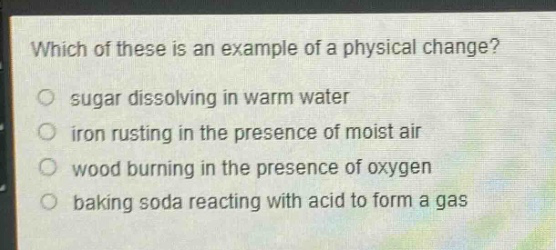
which of these is an example of a physical change?\n sugar dissolving in warm water\n iron rusting in the presence of moist air\n wood burning in the presence of oxygen\n baking soda reacting with acid to form a gas
Answer
Answer:
sugar dissolving in warm water
Explanation:
Step1: Define physical change
A physical change is a change in which the substance's chemical composition remains the same.
Step2: Analyze sugar - water case
When sugar dissolves in warm water, only the state of sugar changes from solid to dissolved in water. Its chemical formula ($C_{12}H_{22}O_{11}$) remains unchanged.
Step3: Analyze iron - rusting case
Iron rusting is a chemical reaction. Iron ($Fe$) reacts with oxygen ($O_2$) and water ($H_2O$) to form iron oxide (rust, mainly $Fe_2O_3\cdot xH_2O$), changing its chemical composition.
Step4: Analyze wood - burning case
Wood burning is a combustion reaction. Wood (organic compounds) reacts with oxygen to produce carbon - dioxide, water vapor, and other substances. The chemical composition of wood changes.
Step5: Analyze baking - soda reaction case
Baking soda ($NaHCO_3$) reacting with acid is a chemical reaction. It forms carbon - dioxide gas, water, and a salt, changing the chemical composition of baking soda.