4) explain why oxygen is a fairly reactive element while neon is not.\n5) explain why beryllium loses…
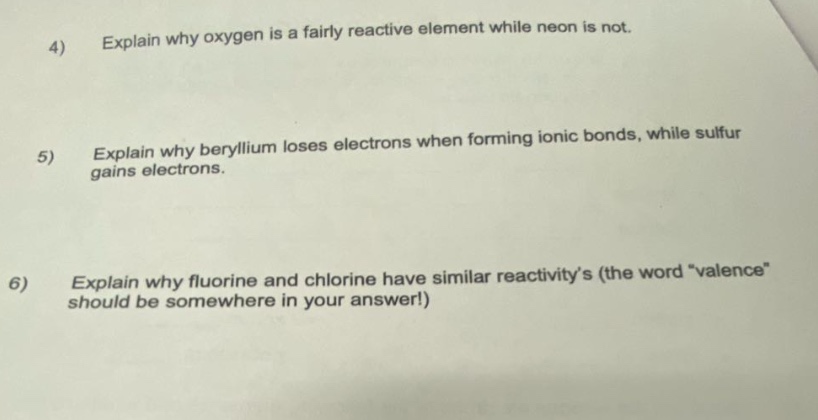
4) explain why oxygen is a fairly reactive element while neon is not.\n5) explain why beryllium loses electrons when forming ionic bonds, while sulfur gains electrons.\n6) explain why fluorine and chlorine have similar reactivity’s (the word “valence” should be somewhere in your answer!)
Answer
Brief Explanations:
Question 4:
Oxygen has 6 valence electrons and wants 8 to achieve a stable octet, so it readily reacts to gain electrons. Neon has a full outer - shell of 8 valence electrons (a stable configuration), so it is unreactive.
Question 5:
Beryllium has 2 valence electrons. It is easier for it to lose these 2 electrons to achieve a stable noble - gas configuration. Sulfur has 6 valence electrons and gains 2 electrons to reach a stable octet.
Question 6:
Fluorine and chlorine are in the same group (Group 17, halogens) and have 7 valence electrons. They both need to gain 1 electron to achieve a stable octet, so they have similar reactivity.
Answer:
Question 4:
Oxygen has 6 valence electrons and needs to gain electrons to achieve a stable octet, while neon has a full outer - shell of 8 valence electrons and is stable.
Question 5:
Beryllium has 2 valence electrons and loses them to achieve a stable configuration; sulfur has 6 valence electrons and gains 2 to reach a stable octet.
Question 6:
Fluorine and chlorine are in the same group, have 7 valence electrons each, and need to gain 1 electron to achieve a stable octet, resulting in similar reactivity.