the expression below was formed by combining different gas laws.\n\n$v\\propto\\frac{nt}{p}$\n\nwhich law…
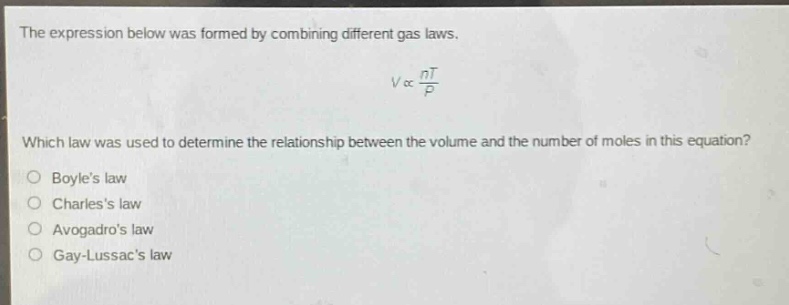
the expression below was formed by combining different gas laws.\n\n$v\\propto\\frac{nt}{p}$\n\nwhich law was used to determine the relationship between the volume and the number of moles in this equation?\no boyles law\no charless law\no avogadros law\no gay - lussacs law
Answer
Brief Explanations:
Avogadro's law states that at constant temperature and pressure, the volume of a gas is directly proportional to the number of moles of the gas. In the given expression $V\propto\frac{nT}{P}$, when $T$ and $P$ are held constant, $V\propto n$ which is in line with Avogadro's law. Boyle's law relates $V$ and $P$ at constant $n$ and $T$. Charles's law relates $V$ and $T$ at constant $n$ and $P$. Gay - Lussac's law relates $P$ and $T$ at constant $V$ and $n$.
Answer:
Avogadro's law