familiar solutions can have a wide range of ph levels. according to the chart, which is the strongest acid…
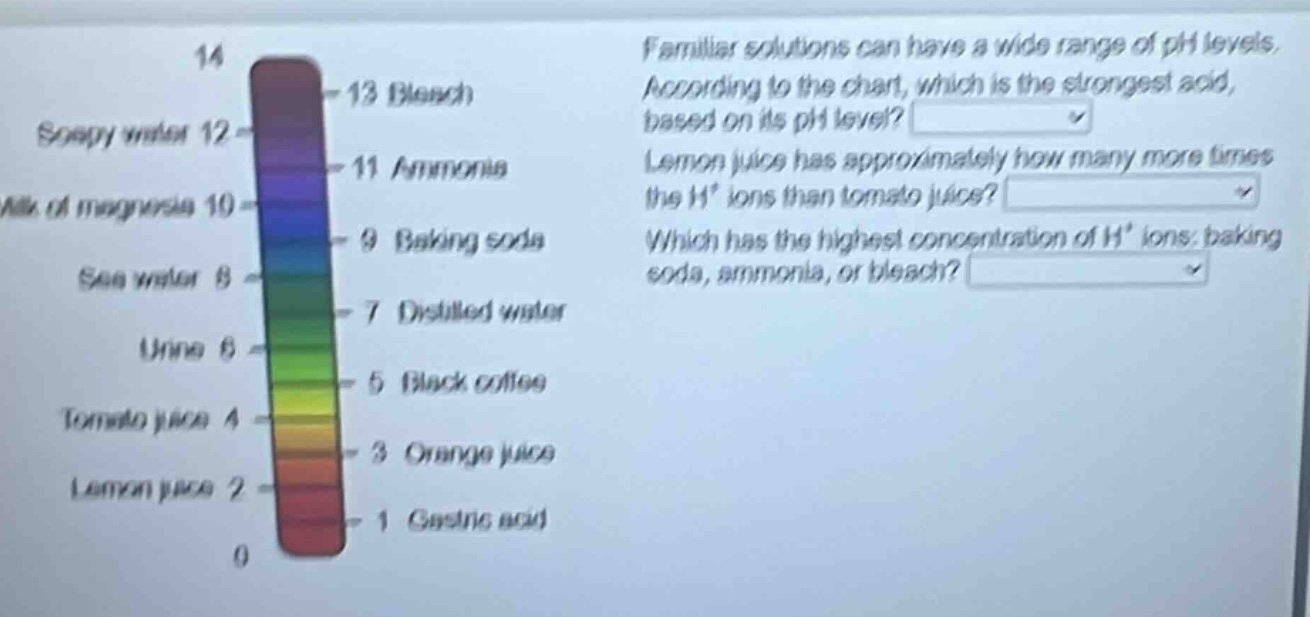
familiar solutions can have a wide range of ph levels. according to the chart, which is the strongest acid, based on its ph level? lemon juice has approximately how many more times the h⁺ ions than tomato juice? which has the highest concentration of h⁺ ions: baking soda, ammonia, or bleach?
Answer
Explanation:
Step1: Recall pH - acid relationship
The lower the pH, the stronger the acid. Gastric acid has the lowest pH (1) among the given substances.
Step2: Use pH formula for ion - concentration
The pH formula is $pH = -\log[H^+]$, so $[H^+]=10^{-pH}$. For lemon juice with $pH = 2$, $[H^+]{lemon}=10^{-2}$. For tomato juice with $pH = 4$, $[H^+]{tomato}=10^{-4}$. The ratio $\frac{[H^+]{lemon}}{[H^+]{tomato}}=\frac{10^{-2}}{10^{-4}} = 10^{(-2-(-4))}=100$.
Step3: Compare pH values for $H^+$ concentration
The lower the pH, the higher the $[H^+]$. Baking soda ($pH = 9$), ammonia ($pH = 11$), bleach ($pH = 13$). Since baking soda has the lowest pH among them, it has the highest $[H^+]$ concentration.
Answer:
- Gastric acid
- 100
- Baking soda