fast focus science standard 5.5.b / page 5 1 which physical property would be most useful in separating wood…
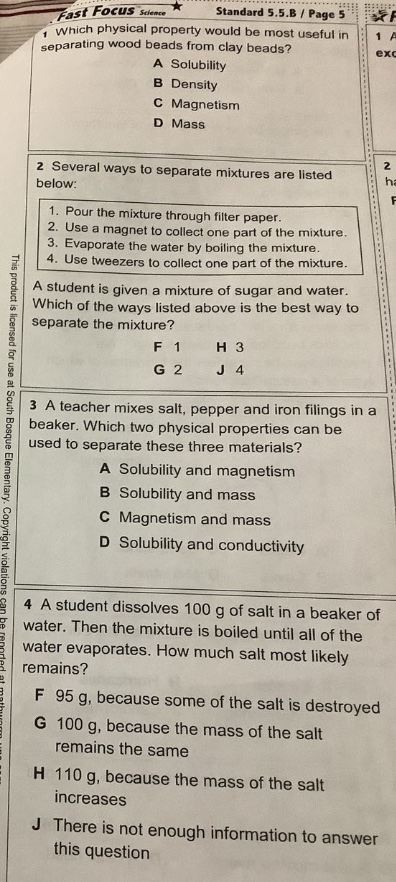
fast focus science standard 5.5.b / page 5 1 which physical property would be most useful in separating wood beads from clay beads? a solubility b density c magnetism d mass 2 several ways to separate mixtures are listed below: 1. pour the mixture through filter paper. 2. use a magnet to collect one part of the mixture. 3. evaporate the water by boiling the mixture. 4. use tweezers to collect one part of the mixture. a student is given a mixture of sugar and water. which of the ways listed above is the best way to separate the mixture? f 1 h 3 g 2 j 4 3 a teacher mixes salt, pepper and iron filings in a beaker. which two physical properties can be used to separate these three materials? a solubility and magnetism b solubility and mass c magnetism and mass d solubility and conductivity 4 a student dissolves 100 g of salt in a beaker of water. then the mixture is boiled until all of the water evaporates. how much salt most likely remains? f 95 g, because some of the salt is destroyed g 100 g, because the mass of the salt remains the same h 110 g, because the mass of the salt increases j there is not enough information to answer this question
Answer
Explanation:
Step1: Analyze question 1
Wood beads and clay beads can be separated by density as they may have different densities and can be separated using methods like flotation.
Step2: Analyze question 2
Sugar is soluble in water. Evaporating water from a sugar - water mixture (boiling the mixture) will separate the sugar as the water evaporates and the sugar remains.
Step3: Analyze question 3
Salt is soluble in water, iron filings are magnetic. These two properties (solubility and magnetism) can be used to separate salt, pepper and iron filings.
Step4: Analyze question 4
According to the law of conservation of mass, when salt is dissolved in water and the water is evaporated, the mass of the salt remains the same as no chemical reaction occurs to change the amount of salt.
Answer:
- B. Density
- H. 3
- A. Solubility and magnetism
- G. 100 g, because the mass of the salt remains the same