most fertilizers contain ammonia (nh₃). ammonia forms when hydrogen reacts with nitrogen. which equation…
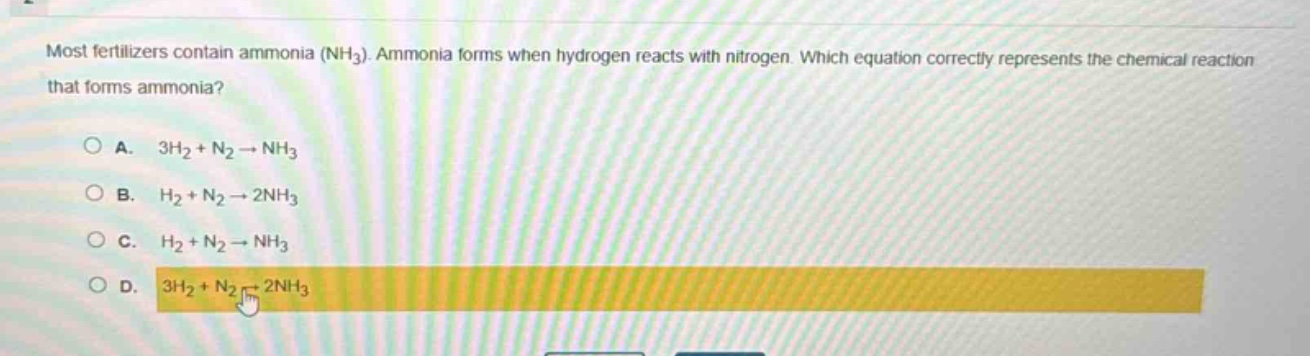
most fertilizers contain ammonia (nh₃). ammonia forms when hydrogen reacts with nitrogen. which equation correctly represents the chemical reaction that forms ammonia?\na. 3h₂ + n₂ → nh₃\nb. h₂ + n₂ → 2nh₃\nc. h₂ + n₂ → nh₃\nd. 3h₂ + n₂ → 2nh₃
Answer
Answer:
D. $3H_2 + N_2\rightarrow2NH_3$
Explanation:
Step1: Check atom conservation
In a balanced chemical - equation, the number of atoms of each element on the reactant side must be equal to the number of atoms of the same element on the product side. For hydrogen ($H$): In option D, on the reactant side, we have $3H_2$, so the number of hydrogen atoms is $3\times2 = 6$. On the product side, we have $2NH_3$, so the number of hydrogen atoms is $2\times3=6$. For nitrogen ($N$): On the reactant side, we have $N_2$, so the number of nitrogen atoms is 2. On the product side, we have $2NH_3$, so the number of nitrogen atoms is 2.
Step2: Analyze other options
In option A, $3H_2 + N_2\rightarrow NH_3$, on the reactant side, there are 6 hydrogen atoms and 2 nitrogen atoms, but on the product side, there are 3 hydrogen atoms and 1 nitrogen atom, so it is not balanced. In option B, $H_2+N_2\rightarrow2NH_3$, on the reactant side, there are 2 hydrogen atoms and 2 nitrogen atoms, while on the product side, there are 6 hydrogen atoms and 2 nitrogen atoms, so it is not balanced. In option C, $H_2 + N_2\rightarrow NH_3$, on the reactant side, there are 2 hydrogen atoms and 2 nitrogen atoms, and on the product side, there are 3 hydrogen atoms and 1 nitrogen atom, so it is not balanced.