fill in the gaps to balance the equation. use the smallest set of whole numbers to balance the equation and…
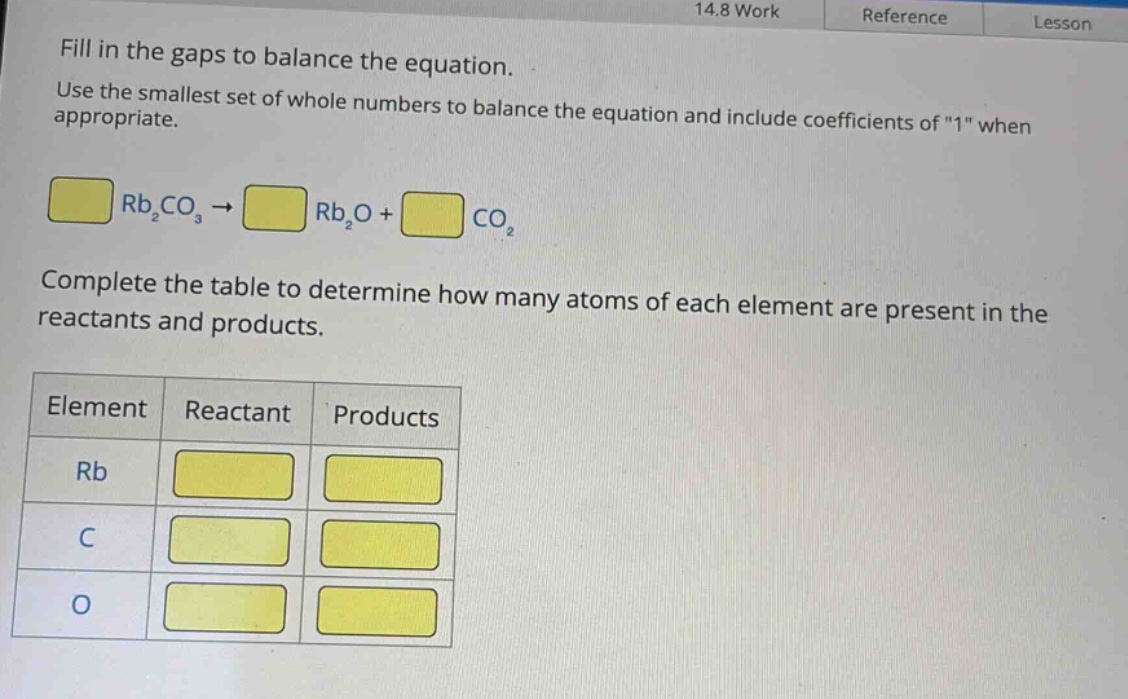
fill in the gaps to balance the equation. use the smallest set of whole numbers to balance the equation and include coefficients of \1\ when appropriate. rb₂co₃ → rb₂o + co₂ complete the table to determine how many atoms of each element are present in the reactants and products. element reactant products rb c o
Answer
Explanation:
Step1: Balance Rb atoms
The number of Rb atoms in $Rb_2CO_3$ is 2. In $Rb_2O$, the number of Rb atoms is also 2. So, the coefficient of $Rb_2CO_3$ and $Rb_2O$ can be 1 for Rb - atom balance.
Step2: Balance C and O atoms
If the coefficient of $Rb_2CO_3$ is 1, then there is 1 C - atom. In $CO_2$, to balance the C - atom, the coefficient of $CO_2$ should be 1. For O - atoms, in $Rb_2CO_3$ there are 3 O - atoms. In $Rb_2O$ there is 1 O - atom and in $CO_2$ there are 2 O - atoms. So the balanced equation is $1Rb_2CO_3\rightarrow1Rb_2O + 1CO_2$.
Step3: Count atoms in reactants and products
- For Rb: In reactant ($Rb_2CO_3$) with coefficient 1, there are 2 Rb atoms. In product ($Rb_2O$) with coefficient 1, there are 2 Rb atoms.
- For C: In reactant ($Rb_2CO_3$) with coefficient 1, there is 1 C atom. In product ($CO_2$) with coefficient 1, there is 1 C atom.
- For O: In reactant ($Rb_2CO_3$) with coefficient 1, there are 3 O atoms. In product ($Rb_2O$) with coefficient 1 there is 1 O - atom and in ($CO_2$) with coefficient 1 there are 2 O - atoms, so total 3 O - atoms in products.
Answer:
For the equation: 1, 1, 1 For the table:
| Element | Reactant | Products |
|---|---|---|
| Rb | 2 | 2 |
| C | 1 | 1 |
| O | 3 | 3 |