a flask contains helium and nitrogen gases. the partial pressures of each are 77 mm hg and 87 mm hg…
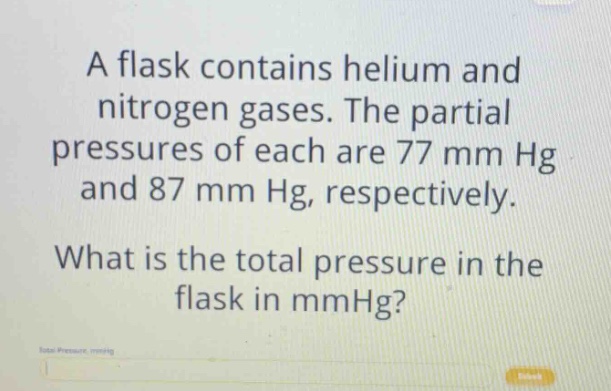
a flask contains helium and nitrogen gases. the partial pressures of each are 77 mm hg and 87 mm hg, respectively. what is the total pressure in the flask in mmhg?
Answer
Explanation:
Step1: Apply Dalton's Law of Partial Pressures
Dalton's Law states that the total pressure (P_{total}) of a mixture of non - reacting gases is the sum of the partial pressures of the individual gases. Mathematically, (P_{total}=P_1 + P_2), where (P_1) and (P_2) are the partial pressures of the gases in the mixture.
Step2: Substitute the given values
Given (P_{He}=77\space mm\space Hg) (partial pressure of helium) and (P_{N_2}=87\space mm\space Hg) (partial pressure of nitrogen). Then (P_{total}=77 + 87).
Step3: Calculate the sum
(77+87 = 164)
Answer:
(164\space mm\space Hg)