which of the following would most likely act as a bronsted - lowry acid?\noh⁻\nhcn\nccl₄\nmg(oh)⁺
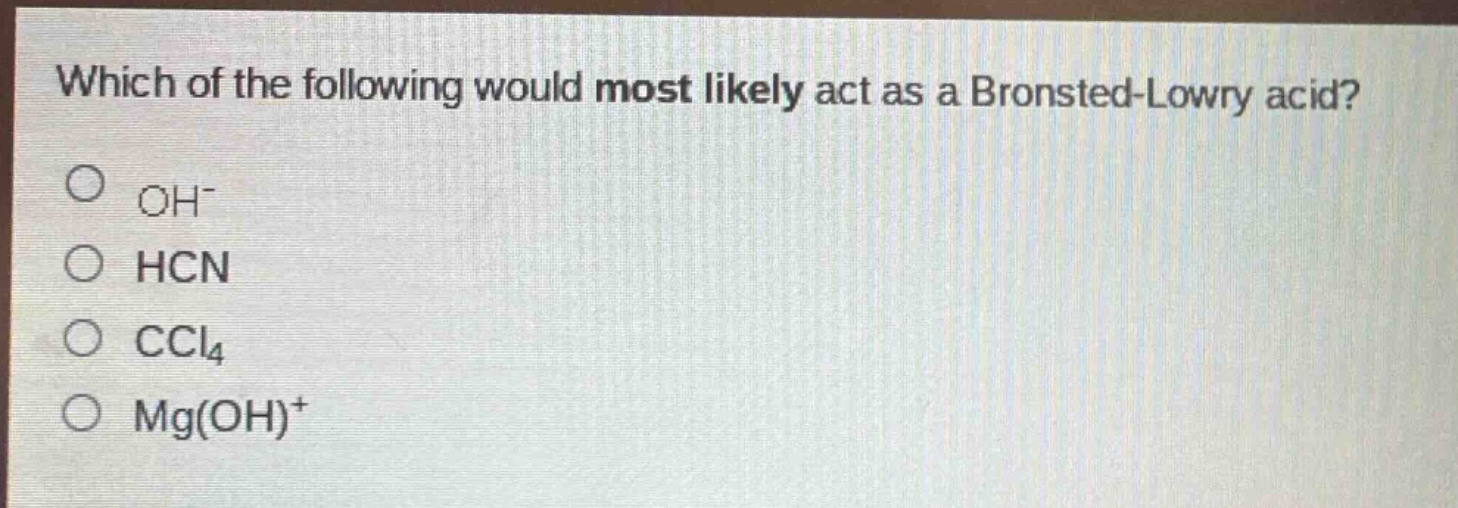
which of the following would most likely act as a bronsted - lowry acid?\noh⁻\nhcn\nccl₄\nmg(oh)⁺
Answer
Explanation:
Step1: Recall Bronsted - Lowry acid definition
A Bronsted - Lowry acid is a substance that can donate a proton ($H^+$).
Step2: Analyze each option
- $OH^-$: It is a hydroxide ion and can accept a proton to form $H_2O$, so it is a Bronsted - Lowry base.
- $HCN$: Hydrocyanic acid can dissociate in solution to release a proton ($H^+$) and form $CN^-$ ion. The reaction is $HCN\rightleftharpoons H^++CN^-$. So it can act as a Bronsted - Lowry acid.
- $CCl_4$: Carbon tetrachloride is a covalent compound and does not have a tendency to donate a proton. It is a non - acidic compound.
- $Mg(OH)^+$: It is a positively charged species and is more likely to accept a proton rather than donate one.
Answer:
HCN