which of the following is an oxidation - reduction reaction?\no so₂(g) + h₂o(l) → h₂so₃(aq)\no caco₃(s) →…
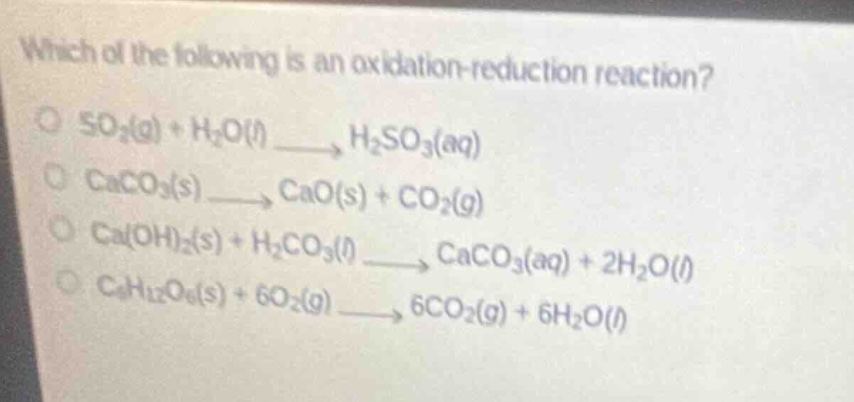
which of the following is an oxidation - reduction reaction?\no so₂(g) + h₂o(l) → h₂so₃(aq)\no caco₃(s) → cao(s) + co₂(g)\no ca(oh)₂(s) + h₂co₃(l) → caco₃(aq) + 2h₂o(l)\no c₆h₁₂o₆(s) + 6o₂(g) → 6co₂(g) + 6h₂o(l)
Answer
Explanation:
Step1: Recall redox - reaction concept
Oxidation - reduction reactions involve a transfer of electrons, which is indicated by a change in oxidation numbers.
Step2: Analyze first reaction
For $SO_2(g)+H_2O(l)\rightarrow H_2SO_3(aq)$, the oxidation numbers of $S$, $O$, and $H$ do not change. S in $SO_2$ has an oxidation number of +4, in $H_2SO_3$ it is also +4.
Step3: Analyze second reaction
For $CaCO_3(s)\rightarrow CaO(s)+CO_2(g)$, the oxidation numbers of $Ca$, $C$, and $O$ remain the same throughout the reaction.
Step4: Analyze third reaction
For $Ca(OH)_2(s)+H_2CO_3(l)\rightarrow CaCO_3(aq)+2H_2O(l)$, this is a double - displacement reaction and there is no change in oxidation numbers.
Step5: Analyze fourth reaction
For $C_6H_{12}O_6(s)+6O_2(g)\rightarrow 6CO_2(g)+6H_2O(l)$, in $C_6H_{12}O_6$, the average oxidation number of $C$ is 0. In $CO_2$, the oxidation number of $C$ is +4. Also, the oxidation number of $O$ in $O_2$ is 0 and in $CO_2$ and $H_2O$ it is - 2. There is a change in oxidation numbers, so it is a redox reaction.
Answer:
$C_6H_{12}O_6(s)+6O_2(g)\rightarrow 6CO_2(g)+6H_2O(l)$