which of the following is an oxidation - reduction reaction?\no fe₂o₃ + 3co → 2fe + 3co₂\no cuso₄ + 2naoh →…
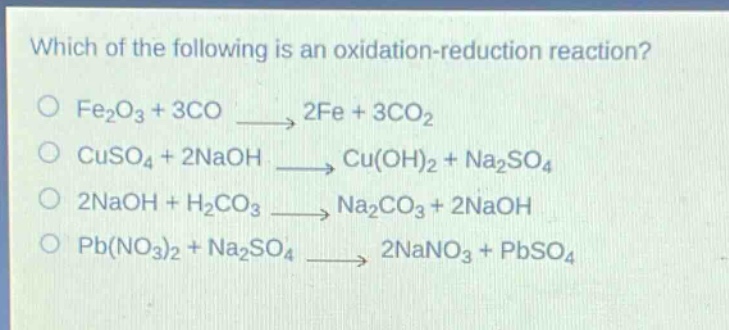
which of the following is an oxidation - reduction reaction?\no fe₂o₃ + 3co → 2fe + 3co₂\no cuso₄ + 2naoh → cu(oh)₂ + na₂so₄\no 2naoh + h₂co₃ → na₂co₃ + 2naoh\no pb(no₃)₂ + na₂so₄ → 2nano₃ + pbso₄
Answer
Brief Explanations:
In an oxidation - reduction reaction, there is a change in oxidation states of elements. In the reaction $\mathrm{Fe_2O_3}+3\mathrm{CO}\rightarrow2\mathrm{Fe}+3\mathrm{CO_2}$, the oxidation state of Fe changes from +3 in $\mathrm{Fe_2O_3}$ to 0 in Fe (reduction), and the oxidation state of C changes from +2 in CO to +4 in $\mathrm{CO_2}$ (oxidation). In the other reactions like $\mathrm{CuSO_4}+2\mathrm{NaOH}\rightarrow\mathrm{Cu(OH)_2}+\mathrm{Na_2SO_4}$, $\ 2\mathrm{NaOH}+\mathrm{H_2CO_3}\rightarrow\mathrm{Na_2CO_3}+2\mathrm{NaOH}$ (typo in this equation likely, but it's a double - displacement type), and $\mathrm{Pb(NO_3)_2}+\mathrm{Na_2SO_4}\rightarrow2\mathrm{NaNO_3}+\mathrm{PbSO_4}$, there is no change in oxidation states of elements and they are double - displacement reactions.
Answer:
$\mathrm{Fe_2O_3}+3\mathrm{CO}\rightarrow2\mathrm{Fe}+3\mathrm{CO_2}$