which of the following is an oxidation - reduction reaction? o fe2o3 + 3co → 2fe + 3co2 o cuso4 + 2naoh →…
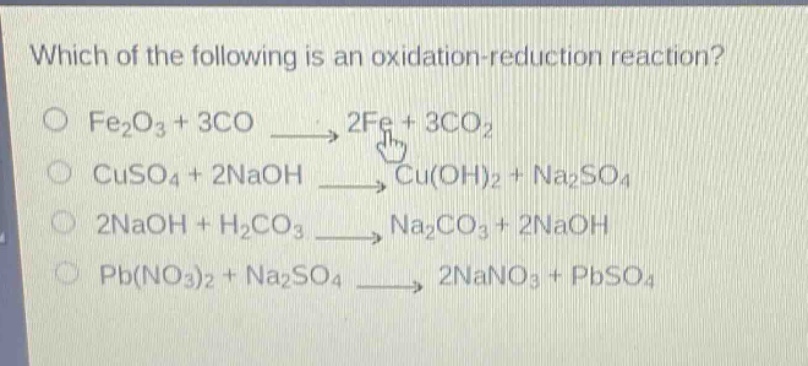
which of the following is an oxidation - reduction reaction? o fe2o3 + 3co → 2fe + 3co2 o cuso4 + 2naoh → cu(oh)2 + na2so4 o 2naoh + h2co3 → na2co3 + 2naoh o pb(no3)2 + na2so4 → 2nano3 + pbso4
Answer
Explanation:
Step1: Recall oxidation - reduction reaction concept
Oxidation - reduction (redox) reactions involve a transfer of electrons, which is indicated by a change in oxidation numbers of elements.
Step2: Analyze the first reaction
In $Fe_2O_3 + 3CO\rightarrow2Fe + 3CO_2$, for iron in $Fe_2O_3$, the oxidation number of Fe is +3, and in elemental Fe it is 0 (decrease in oxidation number - reduction). For carbon in CO, the oxidation number of C is +2, and in $CO_2$ it is +4 (increase in oxidation number - oxidation). So this is a redox reaction.
Step3: Analyze the second reaction
In $CuSO_4+2NaOH\rightarrow Cu(OH)_2 + Na_2SO_4$, this is a double - displacement reaction. The oxidation numbers of all elements ($Cu = + 2$, $S=+6$, $O = - 2$, $Na=+1$, $H = + 1$) remain the same before and after the reaction. So it is not a redox reaction.
Step4: Analyze the third reaction
In $2NaOH + H_2CO_3\rightarrow Na_2CO_3+2NaOH$, this is an acid - base reaction. The oxidation numbers of elements ($Na = + 1$, $O=-2$, $H = + 1$, $C = + 4$) do not change. So it is not a redox reaction.
Step5: Analyze the fourth reaction
In $Pb(NO_3)_2+Na_2SO_4\rightarrow2NaNO_3 + PbSO_4$, this is a double - displacement reaction. The oxidation numbers of elements ($Pb = + 2$, $N=+5$, $O=-2$, $Na = + 1$, $S=+6$) remain constant. So it is not a redox reaction.
Answer:
$Fe_2O_3 + 3CO\rightarrow2Fe + 3CO_2$