the following reaction occurs in a cars catalytic converter.\n2no(g) + 2co(g) → n₂(g) + 2co₂(g)\nwhich…
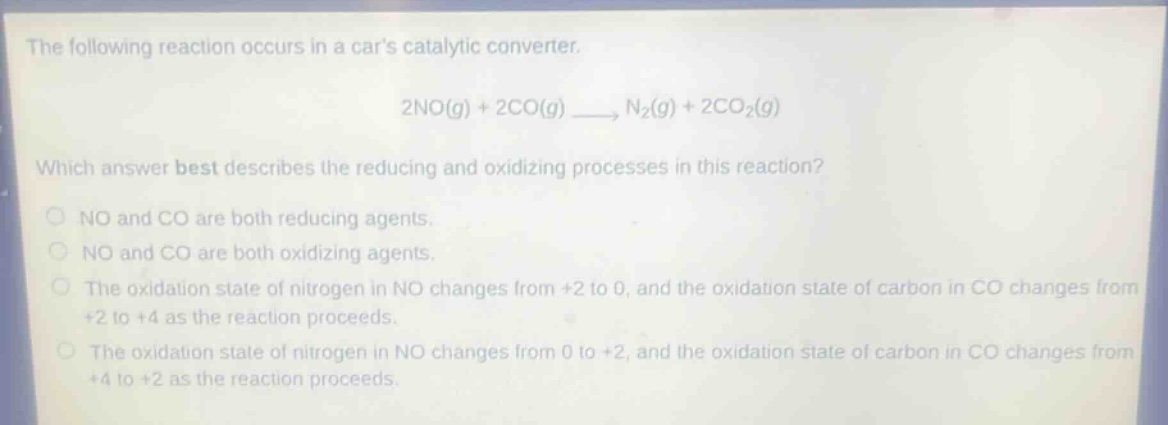
the following reaction occurs in a cars catalytic converter.\n2no(g) + 2co(g) → n₂(g) + 2co₂(g)\nwhich answer best describes the reducing and oxidizing processes in this reaction?\nno and co are both reducing agents.\nno and co are both oxidizing agents.\nthe oxidation state of nitrogen in no changes from +2 to 0, and the oxidation state of carbon in co changes from +2 to +4 as the reaction proceeds.\nthe oxidation state of nitrogen in no changes from 0 to +2, and the oxidation state of carbon in co changes from +4 to +2 as the reaction proceeds.
Answer
Explanation:
Step1: Define oxidizing and reducing agents
An oxidizing agent is reduced (gains electrons, has its oxidation - state decrease), and a reducing agent is oxidized (loses electrons, has its oxidation - state increase).
Step2: Determine oxidation states in reactants
In $NO$, oxygen has an oxidation state of - 2. Let the oxidation state of nitrogen be $x$. Using the rule that the sum of oxidation states in a neutral compound is 0, we have $x+( - 2)=0$, so $x = + 2$. In $CO$, oxygen has an oxidation state of - 2. Let the oxidation state of carbon be $y$. Then $y+( - 2)=0$, so $y = + 2$.
Step3: Determine oxidation states in products
In $N_2$, the oxidation state of nitrogen is 0. In $CO_2$, oxygen has an oxidation state of - 2. Let the oxidation state of carbon be $z$. Then $z+2\times(-2)=0$, so $z = + 4$.
Step4: Analyze oxidation - reduction processes
The oxidation state of nitrogen in $NO$ changes from + 2 to 0 (reduction), so $NO$ is an oxidizing agent. The oxidation state of carbon in $CO$ changes from + 2 to + 4 (oxidation), so $CO$ is a reducing agent.
Answer:
The oxidation state of nitrogen in $NO$ changes from + 2 to 0, and the oxidation state of carbon in $CO$ changes from + 2 to + 4 as the reaction proceeds.