a fully filled acetylene cylinder has a pressure of 220. psi. after 1 week of use, the acetylene cylinder…
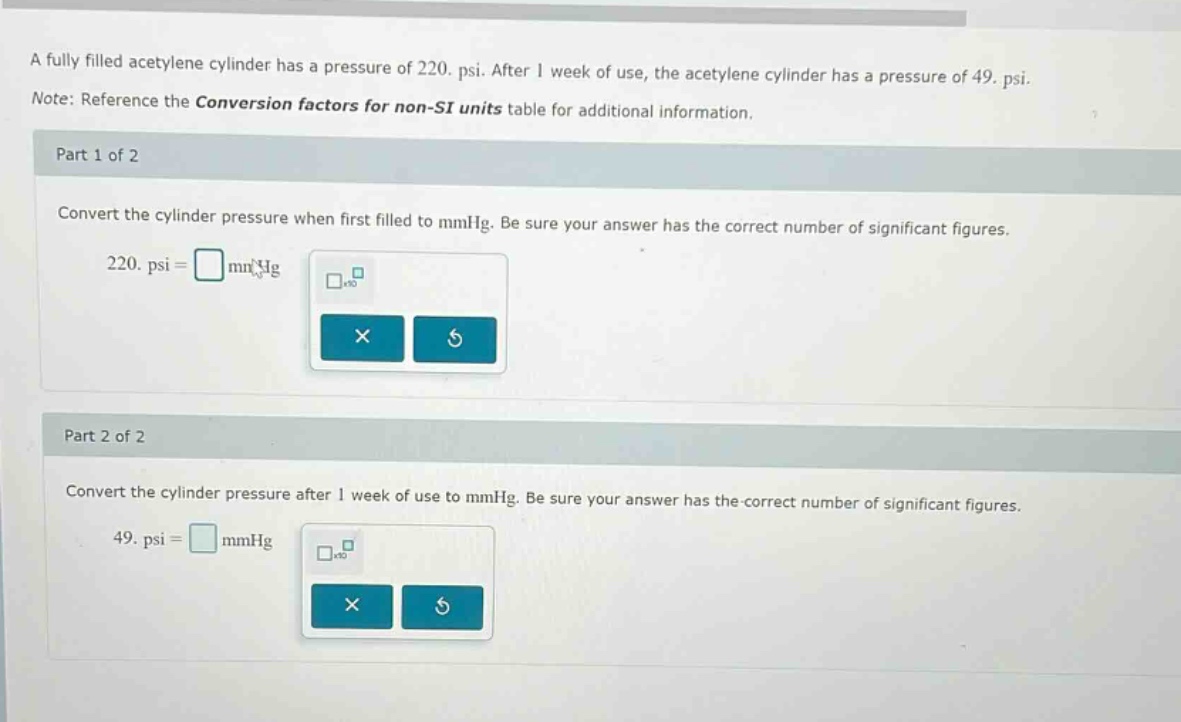
a fully filled acetylene cylinder has a pressure of 220. psi. after 1 week of use, the acetylene cylinder has a pressure of 49. psi. note: reference the conversion factors for non - si units table for additional information. part 1 of 2 convert the cylinder pressure when first filled to mmhg. be sure your answer has the correct number of significant figures. 220. psi = mmhg part 2 of 2 convert the cylinder pressure after 1 week of use to mmhg. be sure your answer has the correct number of significant figures. 49. psi = mmhg
Answer
Explanation:
Step1: Recall pressure - conversion factor
The conversion factor from psi (pounds - per - square - inch) to mmHg (millimeters of mercury) is 1 psi = 51.715 mmHg.
Step2: Convert initial pressure
For the initial pressure of 220. psi, we multiply by the conversion factor: $220.\times51.715 = 11377.3$ mmHg. Rounding to 3 significant figures (since 220. has 3 significant figures), we get 11400 mmHg.
Step3: Convert pressure after 1 - week use
For the pressure of 49. psi after 1 - week use, we multiply by the conversion factor: $49.\times51.715=2534.035$ mmHg. Rounding to 2 significant figures (since 49. has 2 significant figures), we get 2500 mmHg.
Answer:
Part 1 of 2: 11400 mmHg Part 2 of 2: 2500 mmHg